
Beginner's guide
Your First Campervan Trip in Japan: The Complete Beginner's Guide, from Renting in Osaka to Your First Night (with Support in Four Languages)
Plenty of people like the idea of a campervan trip and then stall on three questions: can I drive something that big, where do I park it at night, and who do I ask when something goes wrong halfway through? This guide is for anyone renting a camper in Osaka for the first time. It walks through what actually happens, in order: five minutes of booking, an hour of handover, your first night, the driving and the return. It also covers what sets DREAMAX apart: once you are on the road, our staff are still there for you in four languages, Japanese, English, Cantonese and Mandarin, by WhatsApp, LINE or phone. Rather than simply promising that beginners will be fine, this page shows what that looks like in real situations.
By Gary, campervan & car-camping advisor at DREAMAX
Who this guide is for
It is written for people who have never driven a camper, never slept in a vehicle, or never driven in Japan at all. That includes visitors who land at Kansai International Airport and want to set off the same day, and people living in Osaka or elsewhere in Kansai who want to try one weekend before committing to a longer trip.
You do not need a special licence to drive a camper in Japan. All DREAMAX campers are automatic and can be driven on a standard car licence, including an automatic-only one. Some models do set an age and licence-tenure requirement, covered in the next section. Beyond that, a beginner needs three things: a vehicle of the right size, a booked place to sleep on the first night, and someone to ask when something is unclear. This guide fills in each of those in turn.
- First-time campervan drivers and first-time car campers
- Overseas visitors driving in Japan for the first time (an International Driving Permit or an official translation is required)
- Anyone who wants to try a single night first (there is no minimum rental length)
- Travellers who would rather ask questions in English, Cantonese or Mandarin than in Japanese
Choosing the size: kei, under 4 m, or nearly 5 m
The first two decisions are how many people will sleep in the van and how large a vehicle you are comfortable driving. DREAMAX campers come in three sizes by length. All are automatic and all take regular petrol.
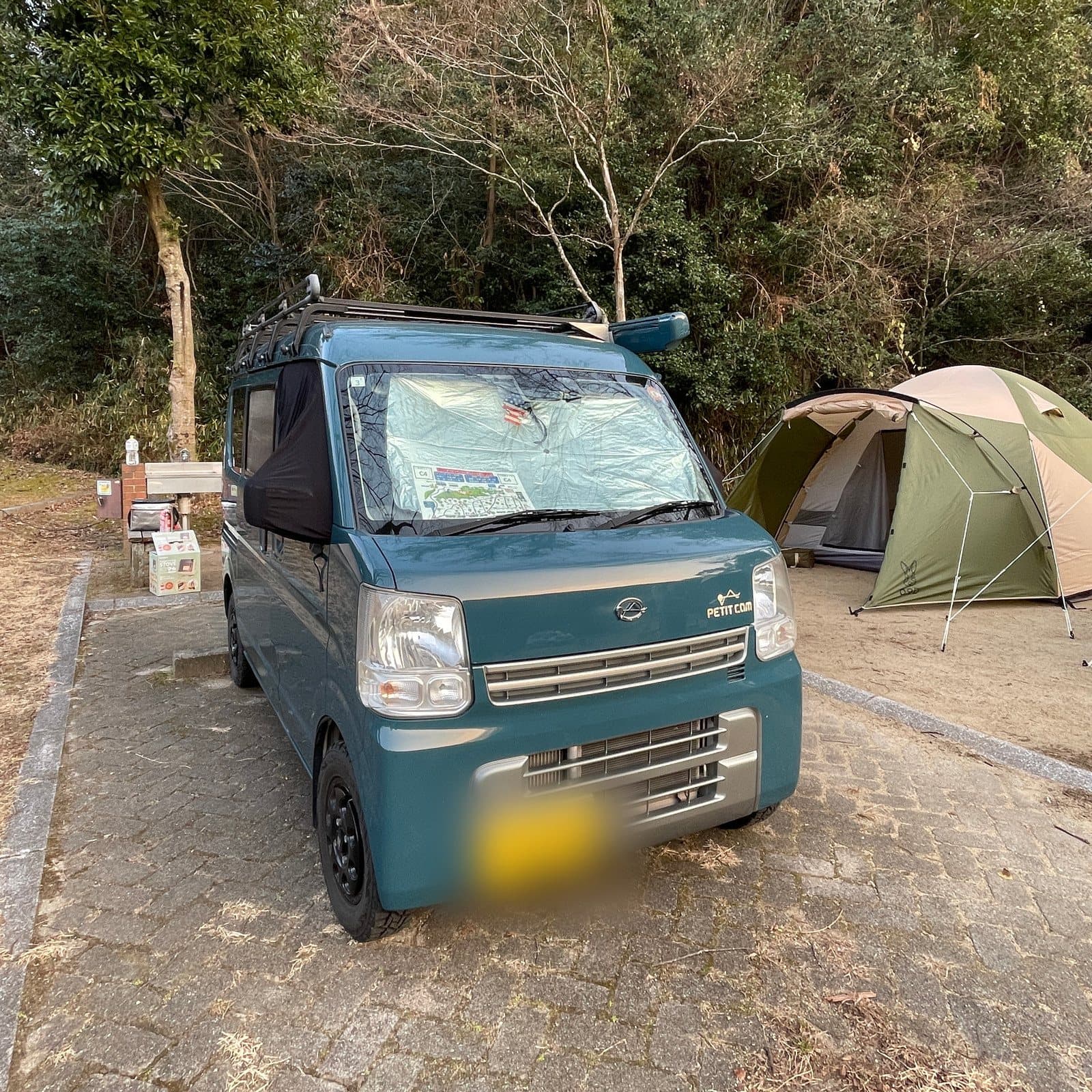
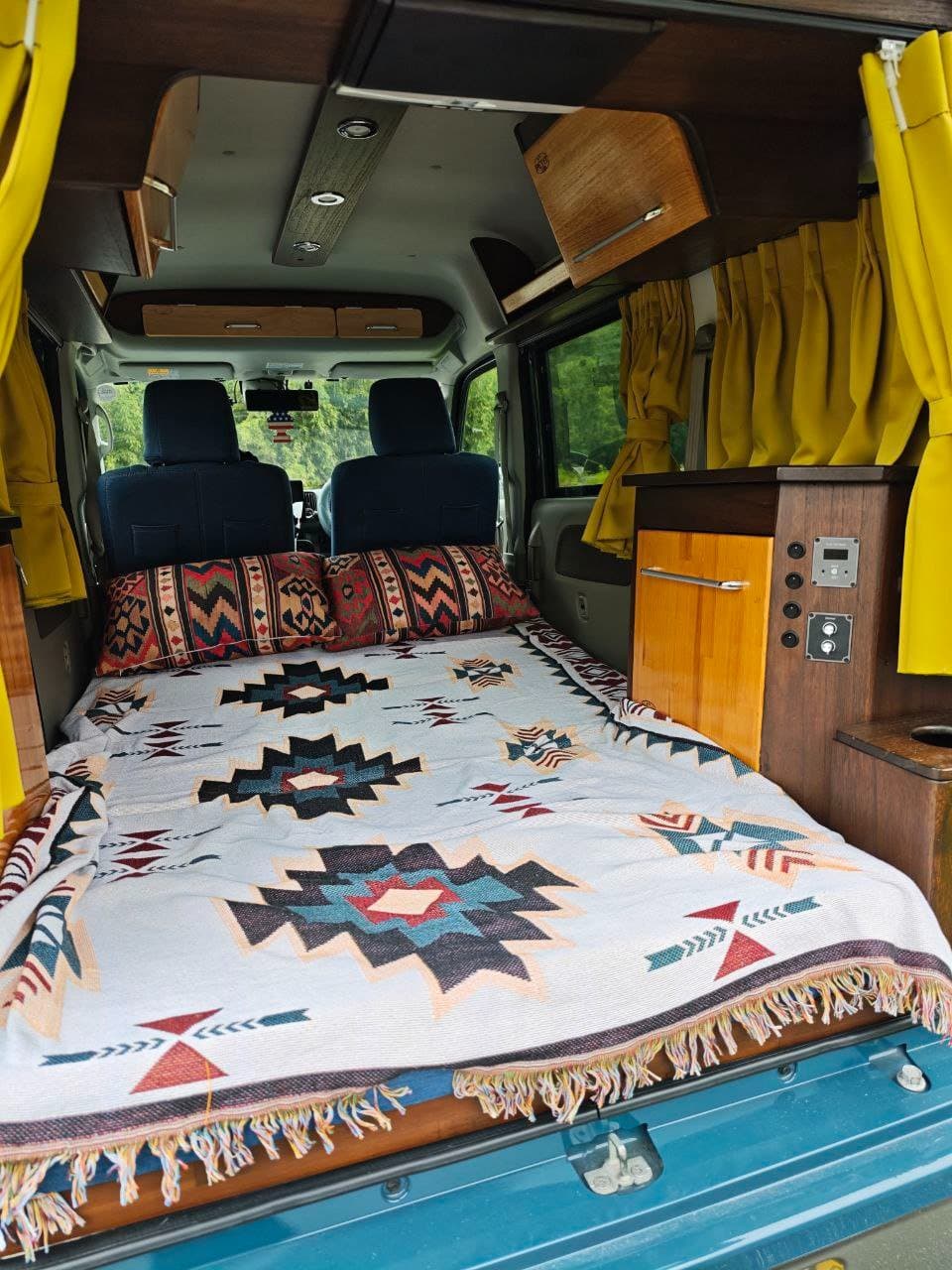
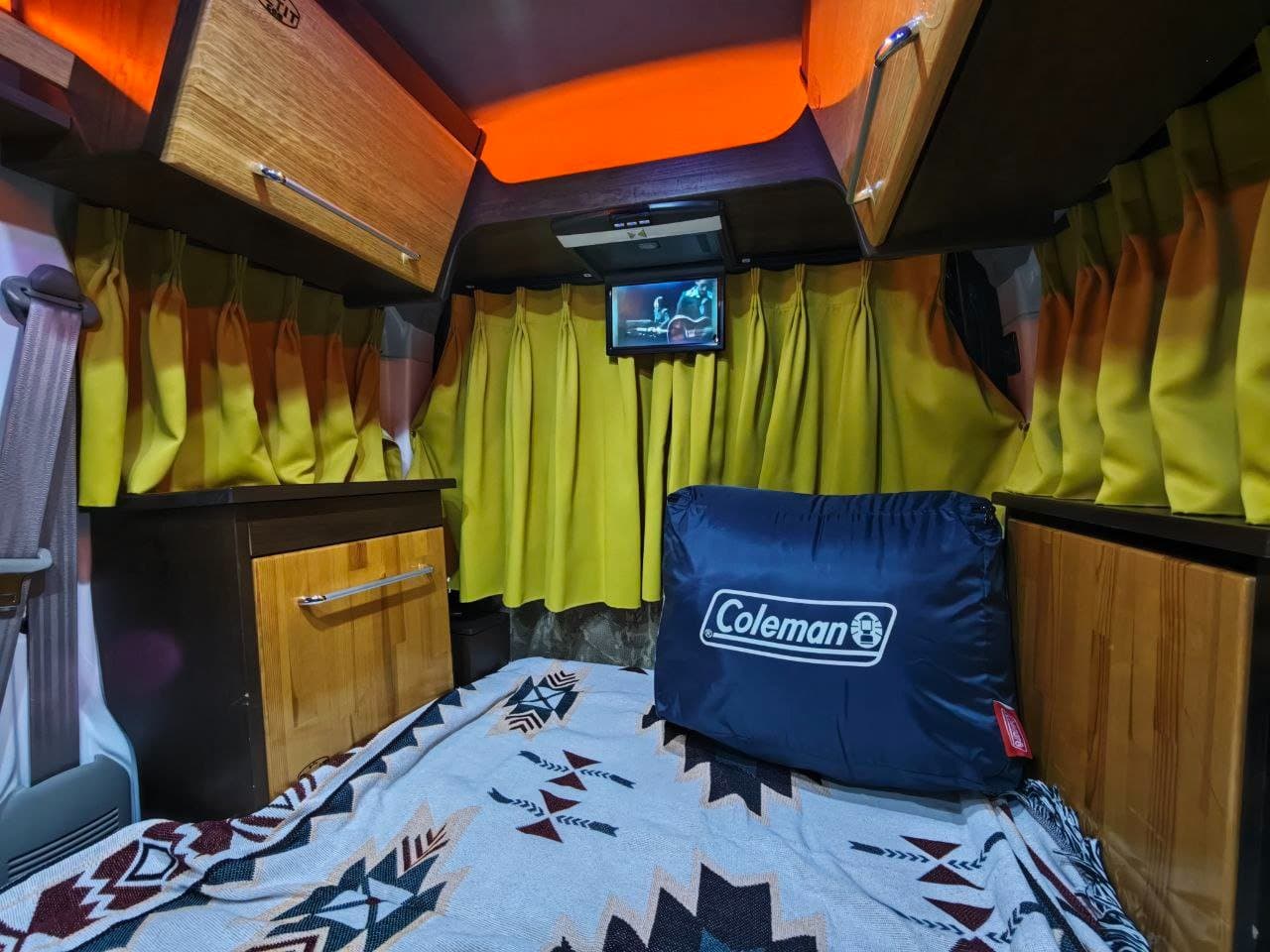
The Petit-Cam Villa (a Suzuki Every) is a kei camper 3,395 mm long, 1,475 mm wide and 2.0 m tall, the same footprint as an ordinary kei van. It seats two and sleeps two on a wide, flat bed, which makes it a natural fit for a couple. Its small size takes the stress out of tourist car parks and narrow streets. It is also the one camper with no stated age or licence-tenure requirement, so it is the option for drivers who passed their test recently.
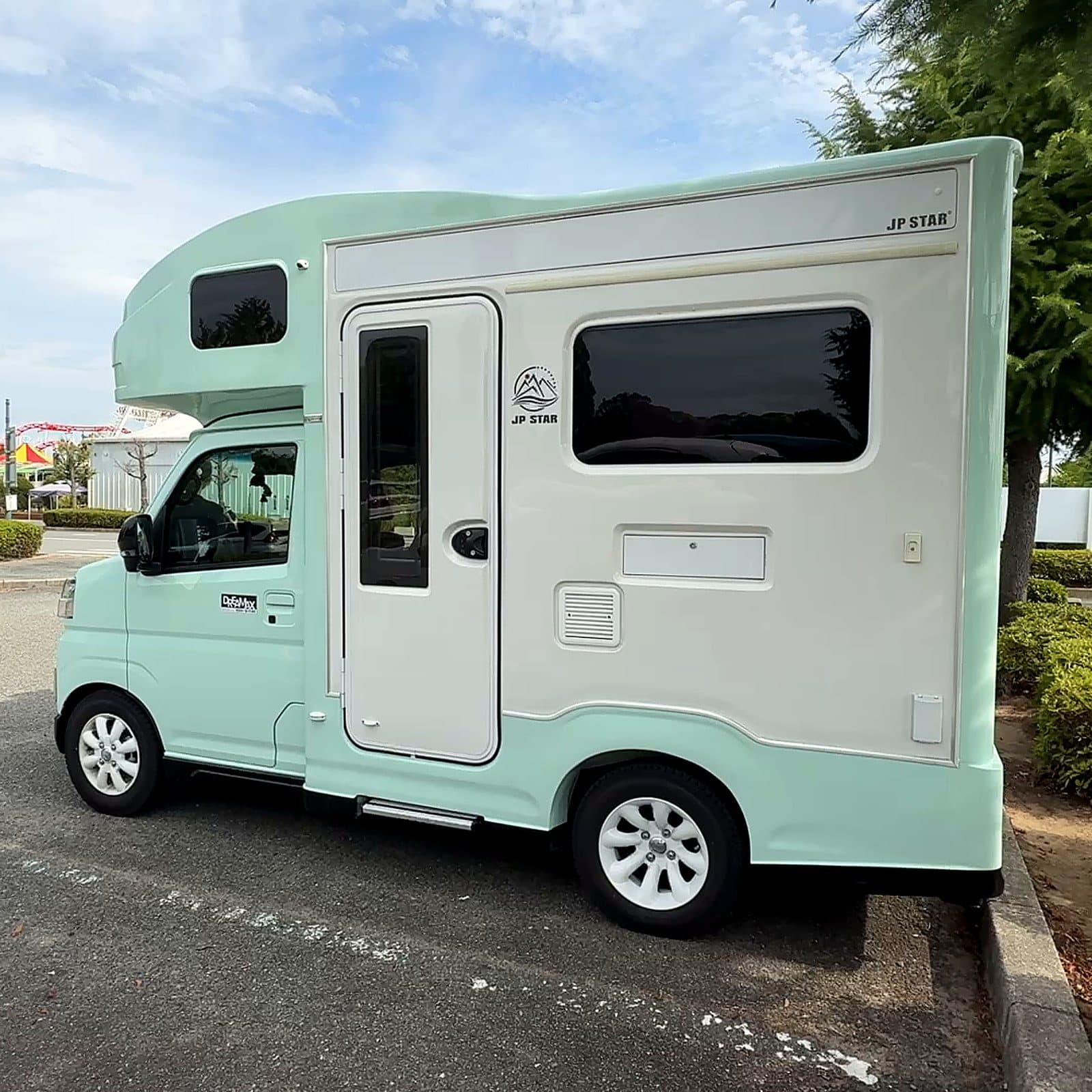
The JP STAR Happy 1 Turbo is a kei camper 3,880 mm long, just under 4 m, 1,690 mm wide and 2.6 m tall. It seats four and sleeps four: a double bunk above the cab, and a living area whose table comes out to make a bed for two adults. It has a fridge, sink and microwave, air-conditioning, and an FF heater (fuel-fired) plus floor heating — two heating systems. There is an outdoor shower for rinsing feet and sand (not for bathing), and a 400 Ah (5,120 Wh) lithium-ion battery with a 3,000 W inverter, so the climate control runs with the engine off. A 360-degree around-view monitor comes as standard, which is a real help for anyone who dreads parking.
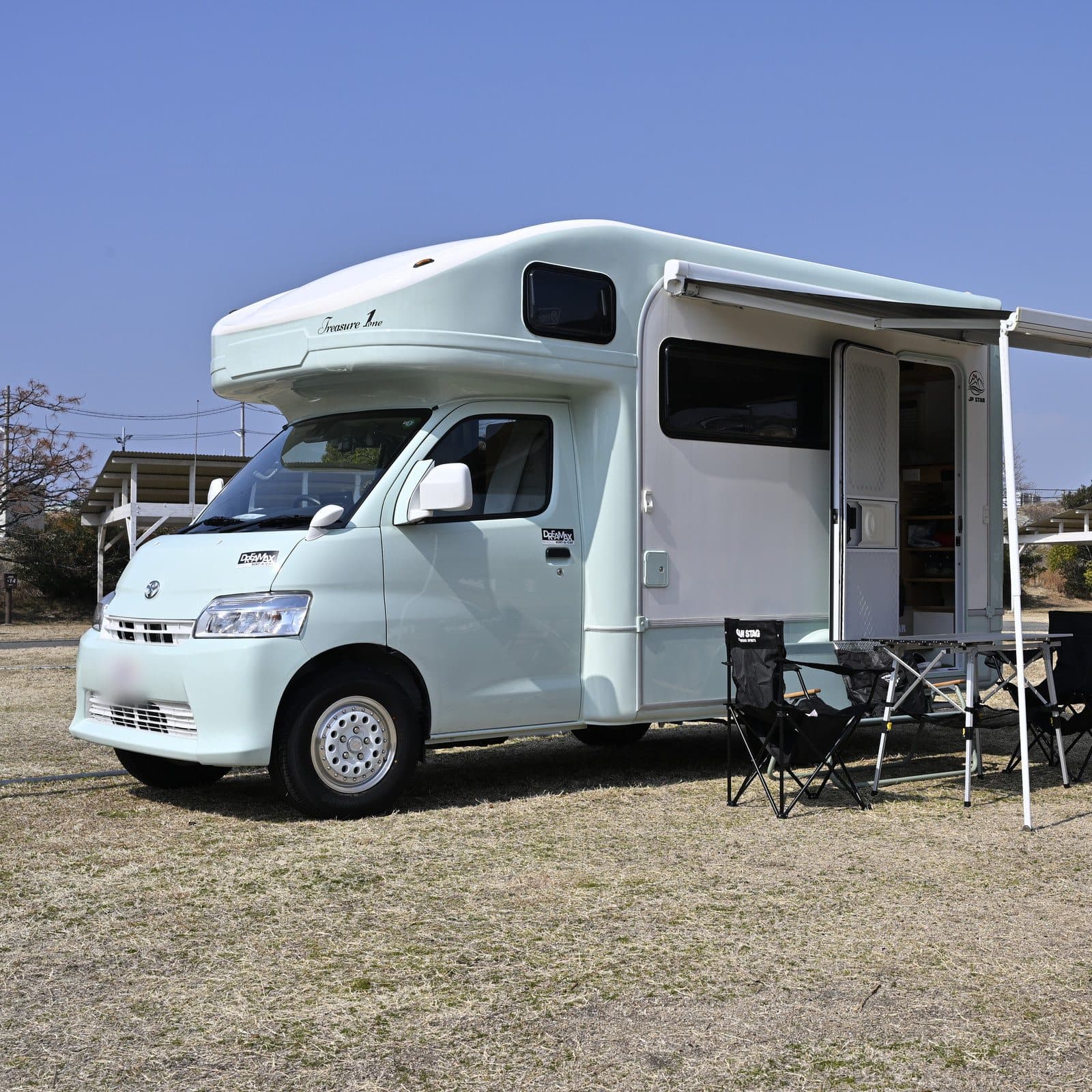
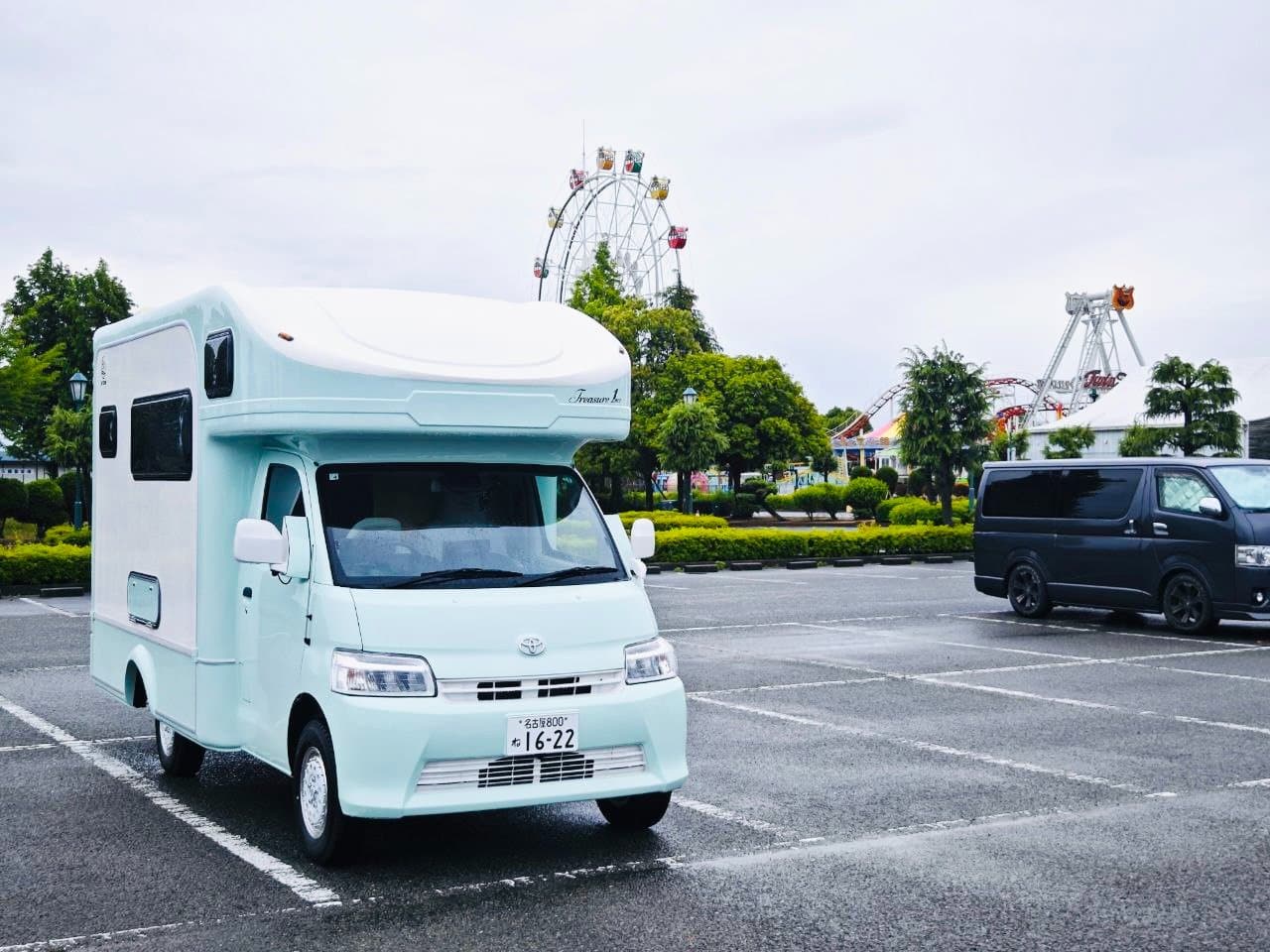
The JP STAR Treasure 1 is the fully equipped option at 4,900 mm long, 1,990 mm wide and 2.8 m tall. It seats six and sleeps four adults plus two children. Along with an IH cooktop, extractor fan, microwave, fridge and sink, it has an outdoor shower fed from a 60-litre fresh-water tank (for rinsing feet and sand, not for bathing), and the same 5,120 Wh battery and 3,000 W inverter as the Happy 1 Turbo. It is the camper for families and groups of three or four who want to live in the van, but its width and height call for extra care during your first hour at the wheel.
In car parks, height causes more trouble than length. Most multi-storey and underground car parks have a height limit that a 2.6 m or 2.8 m vehicle will not clear. Compare the sign at the entrance with your vehicle's height every time, and choose open, ground-level car parks. Even the 2.0 m Petit-Cam Villa will not fit under the lowest barriers. At coin-operated car parks, check that the van fits within a single bay.
Driver requirements differ by vehicle. For the Treasure 1 and the Happy 1 Turbo, every driver must be at least 23 and have held a licence for at least three years; with a Japanese licence, these two cannot be rented to holders of a green-band licence, the first licence issued to new drivers. The Petit-Cam Villa states no age or tenure requirement. If you are unsure, the rule of thumb is: two people, the Petit-Cam Villa; three or four, the Happy 1 Turbo; a family with children, the Treasure 1.
- Petit-Cam Villa: L 3,395 × W 1,475 × H 2,000 mm; 658 cc turbo, automatic; seats 2, sleeps 2; no stated age or licence-tenure requirement
- JP STAR Happy 1 Turbo: L 3,880 × W 1,690 × H 2,600 mm; 660 cc, automatic, 4WD; seats 4, sleeps 4; 5,120 Wh battery, air-conditioning, FF heater plus floor heating (two heating systems), outdoor shower, 360-degree monitor; drivers 23+ with 3+ years licensed
- JP STAR Treasure 1: L 4,900 × W 1,990 × H 2,800 mm; 1,496 cc, automatic, 4WD; seats 6, sleeps 4 adults + 2 children; 5,120 Wh battery, kitchen, FF heater plus household air-con heating (two heating systems), outdoor shower; drivers 23+ with 3+ years licensed
Booking in five minutes: what to prepare, the cut-off and the deposit
Booking is done entirely online. Choose the camper and dates, add any equipment, write the handover place and time in the notes, and pay. The price breakdown updates as you go, so you see the full rental cost before paying; the only charges after the return are for what you actually used, such as ETC tolls. There is no minimum rental length, so one night is fine, and rentals of seven days or more get 10% off the vehicle rate automatically (20% from 14 days, 30% from 28).
What you need is your licence. Visitors from overseas bring three documents: an International Driving Permit issued under the 1949 Geneva Convention, their home licence and their passport. Licences from Taiwan, Switzerland, Germany, France, Belgium and Monaco are used with an official Japanese translation (e.g. from JAF, or your country's embassy or consulate in Japan) instead of an IDP. Hong Kong licence holders need an IDP, and licences from mainland China are not accepted for driving in Japan. Residents of Japan bring their Japanese licence and an ID document. If you enter your licence details online before you travel, on the day only the originals need to be checked.
Bookings close at 12:00 Japan time. Book before noon and the earliest pickup is the next day; book after noon and it is the day after that. The cut-off is always Japan time, so from Hong Kong or Taiwan it falls at 11:00 local time. Same-day bookings cannot be made online; message DREAMAX on WhatsApp or LINE to ask what is available, though nothing is guaranteed.
The deposit is paid before your departure date and refunded within one month of the return, not at the counter. The month allows for charges that are not final on the day, such as actual ETC tolls, a refuelling service or a traffic fine. Those are deducted and the rest goes back to the card you paid with; we absorb the card-processing fee. Cancellation is a full refund up to 15 days before pickup, 70% at 8 to 14 days, 50% at 4 to 7 days and nothing within 3 days, less a 4% payment fee in each case.
- Cut-off: book before 12:00 JST for pickup the next day at the earliest; after 12:00, the day after
- Handover: free in Osaka city and at Kansai Airport (you cover tolls and fuel for that leg)
- Free of charge: the ETC card, infant seats and booster seats
- Deposit: the balance after charges is refunded to your card within one month of the return
Handover day: what you learn in about an hour
Handover takes place at your Osaka hotel, at Kansai International Airport or at the DREAMAX office in Higashisumiyoshi, Osaka. Osaka city and Kansai Airport are free apart from the tolls and fuel for that leg. The office is open from 08:00 to 20:00; a handover outside those hours needs to be arranged in advance.
The handover starts with a check of the original documents. You confirm the contract you agreed to online and sign the paper rental certificate (the kashiwatashisho). Then we walk round the vehicle together to note any existing marks before going inside. Allow about an hour in total.
Inside, the walkthrough runs in the order you are most likely to need things once you are on your own. Try anything you are unsure of while the staff member is still beside you, and film the parts you want to remember on your phone: at 9 pm, rewatching a video is far easier than trying to recall a spoken explanation.
Before you leave, go over that night's sleeping spot with the staff. On the first night, a booked RV park or auto campsite with power and toilets lets you try what you have just learned without any pressure. For the first 30 minutes, keep to main roads at an easy pace.
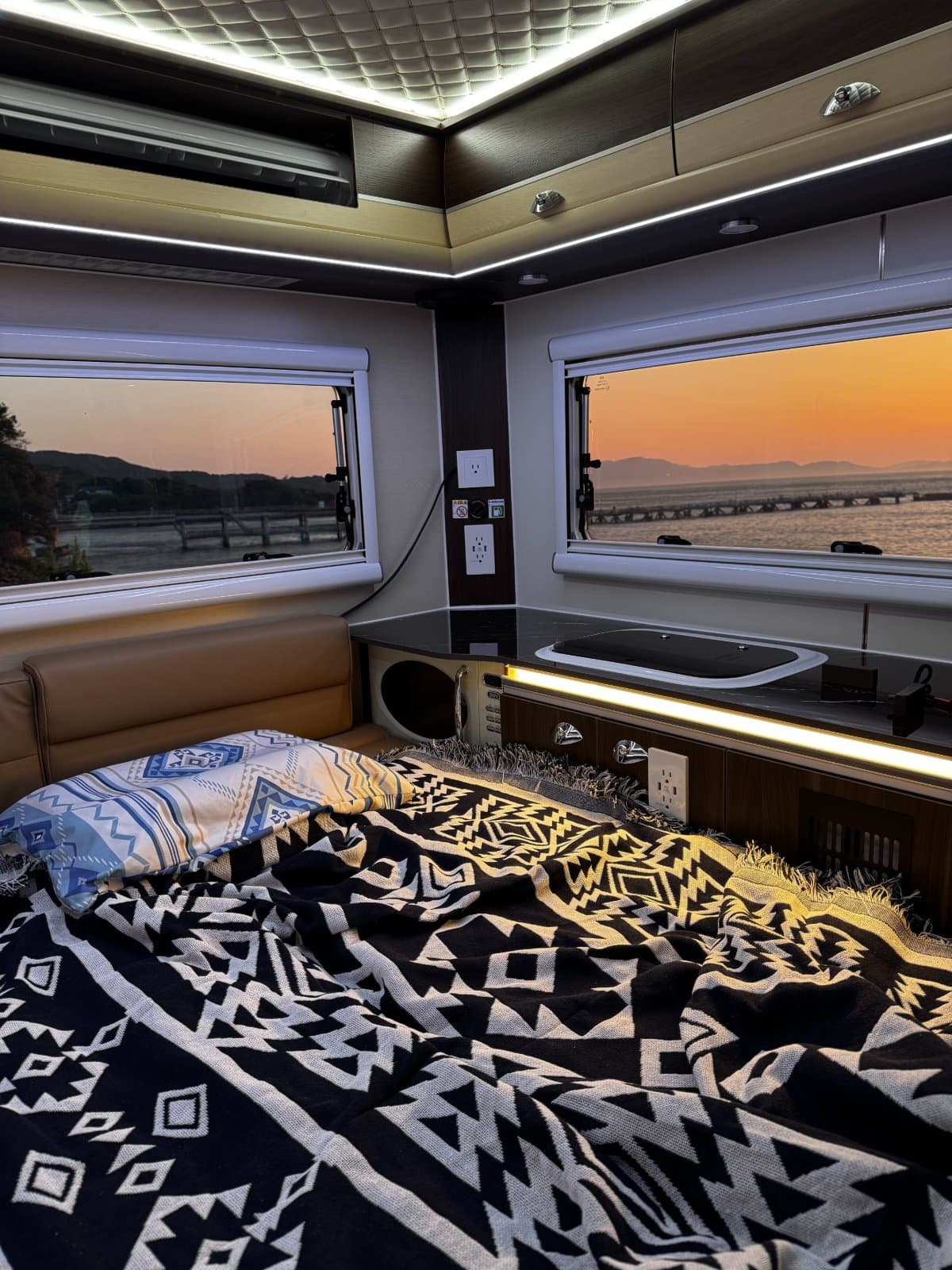
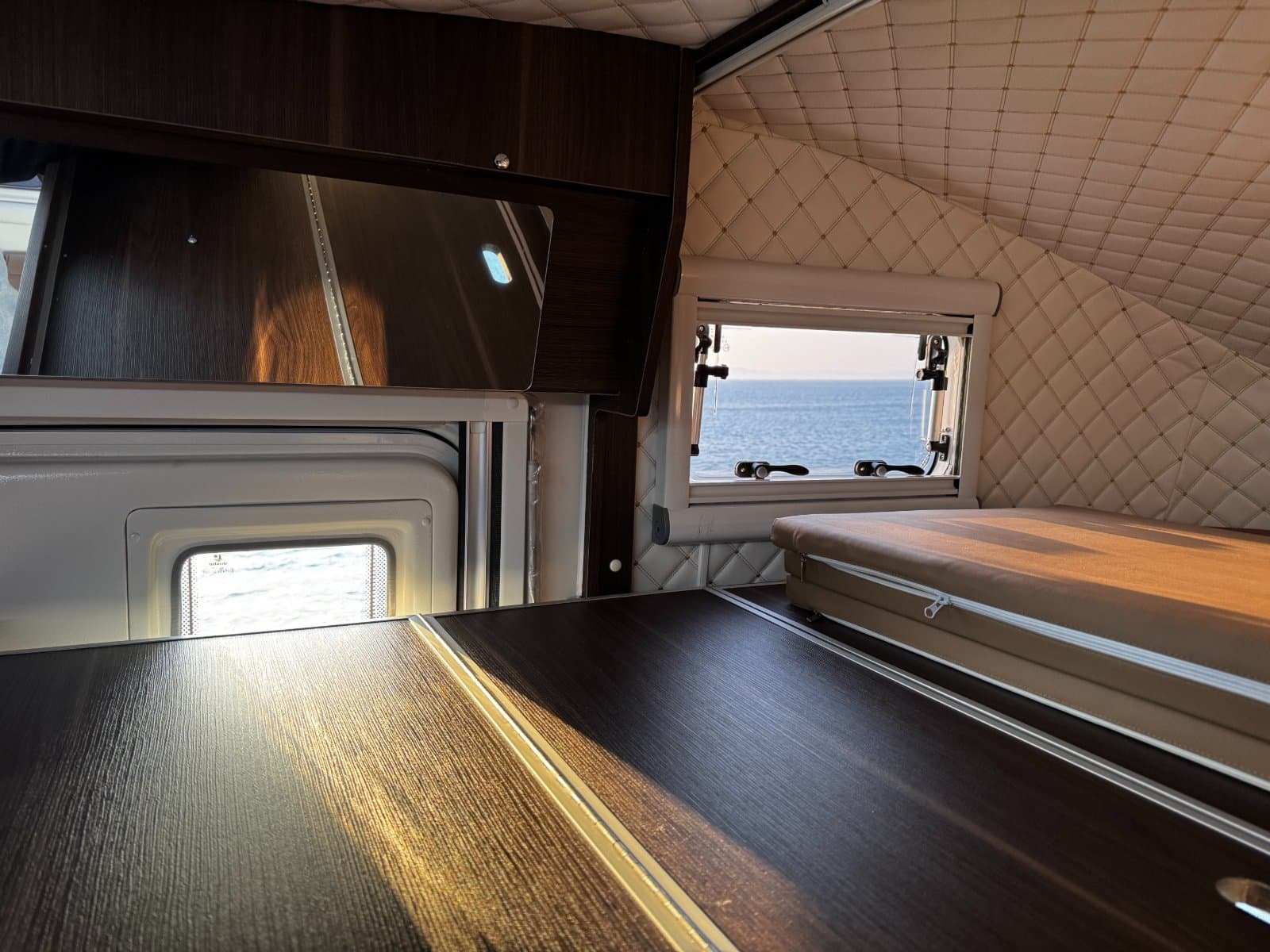
- Beds: the Treasure 1's table lowers into a king-size bed with no tools; the Happy 1 Turbo's table comes out for a two-adult bed; both have a double bunk over the cab
- Power: reading the 400 Ah (5,120 Wh) battery level, switching on the 3,000 W inverter, plugging into shore power at an RV park, and how solar and driving recharge it
- Fridge and microwave: both run on the battery with the engine off
- Water: filling and draining the Treasure 1's 60-litre fresh-water tank (the drain is under the vehicle and takes a few minutes); the tank must be emptied before heading anywhere below freezing (rental terms, Article 14)
- Heating: the Treasure 1 has an FF heater (fuel-fired) plus electric household air-con heating, the Happy 1 Turbo an FF heater (fuel-fired) plus floor heating — two heating systems in each, and the FF heater works without shore power; the Petit-Cam Villa has no built-in heater, so in winter rent the ceramic heater (it needs AC 100 V) and bring sleeping bags
- Awning: putting the powered awning out and back in, and never deploying it at a roadside station or service area
- Driving: the vehicle's length, width and height, the ETC unit and card, where the fuel filler is, and regular petrol
Driving a camper in Japan: height, width, ETC, mountain roads and fuel
Japan drives on the left. Where no limit is posted, the maximum is 60 km/h on ordinary roads and 100 km/h on expressways. Everyone wears a seatbelt, and children under six must be in a child seat, which DREAMAX lends free. Come to a complete stop before every railway crossing.
What catches beginners out is that a camper is taller and wider than the cars they know. Watch for railway underpasses, tunnels, petrol-station canopies, drive-throughs and overhanging branches. Whenever you see a height-limit sign, compare it with your vehicle: 2.8 m for the Treasure 1, 2.6 m for the Happy 1 Turbo, 2.0 m for the Petit-Cam Villa. A tall vehicle also catches crosswinds on bridges and at tunnel exits, so keep both hands on the wheel there.
The Treasure 1 is 1,990 mm wide, so take narrow lanes slowly and allow for the rear wheels cutting inside on left turns. When reversing, the most reliable method is to have a passenger get out and guide you. The Happy 1 Turbo has a 360-degree around-view monitor and the Treasure 1 a reversing camera.
Every vehicle has an ETC unit, and the ETC card is lent free. At expressway toll plazas, use the ETC lanes, marked in purple, and enter slowly, at 20 km/h or less, so the barrier has time to lift. Tolls are settled after the return and deducted from the deposit by default.
On mountain routes, a sat-nav set to the shortest route will sometimes pick a narrow pass. On a first trip, favour expressways and national routes even if the way is a little longer. On long descents, do not ride the foot brake; shift to a lower range and let engine braking do the work. Check how that is done on your vehicle during handover.
From November to April, the Treasure 1 and Happy 1 Turbo run studless winter tyres and the Petit-Cam Villa all-terrain tyres with the snowflake (3PMSF) mark. If your route crosses a chain-control section, tell us your destination when you book and we will lend you chains.
All three campers take regular petrol. Check the pump label so you do not fill up with diesel; in Japan, regular is usually the red nozzle and diesel the green one. In the mountains and at night, fewer stations are open, so refuel whenever the gauge drops below half. Most stations are self-service with Japanese-language screens; if one has you stuck, send a photo of the screen and staff will talk you through it.
Where to sleep: RV parks, roadside stations and campsites
There are three kinds of place to spend the night in a vehicle in Japan, and the key is to tell apart the places where you may sleep from the places where you may rest.
An RV park is a paid car park set up for people staying overnight in a vehicle. Most take bookings and cost around ¥3,000 to ¥5,000 a night. They usually offer power, rubbish disposal and somewhere to bathe nearby, which makes them the best choice for a beginner's first night.
An auto campsite lets you park on a pitch and put up a tent or tarp. Here you can set out chairs and a table, open the awning and barbecue in the designated area. Choose a pitch with power and the battery level stops being a concern.
Roadside stations (michi-no-eki) and expressway service and parking areas (SA/PA) are rest facilities for drivers. Japan's Ministry of Land, Infrastructure, Transport and Tourism states that roadside stations are rest facilities and asks people not to use their car parks for the purpose of staying the night. Pulling in for a nap when you are tired on a long drive is part of resting; treating the car park as a campsite is not.
Wherever you stop, the same rules apply.
To find somewhere for tonight, use the DREAMAX Connect database. As of September 2026 it lists more than 7,900 places across Japan, including more than 3,990 where you can stay overnight in a vehicle, each with its official source, plus 31 campervan routes of 1–7 days from Osaka. Facilities at roadside stations, SA/PA, RV parks and auto campsites, such as night-time toilets, are shown with the source and the date it was checked.
- Do not leave the engine idling. The Treasure 1 and Happy 1 Turbo run heating and cooling from the FF heater and the battery with the engine off
- At roadside stations and SA/PA: no chairs or tables outside, no awning, no fires
- Take your rubbish with you; roadside-station bins are for things bought in the shop
- Keep quiet after 22:00, including car doors and voices
- Do not linger in the morning; free up the space for the next driver
On the road, you are not alone: support in four languages
However thorough the handover, the real questions come once you are on your way. With DREAMAX, our staff stay with you for the whole trip, answering in four languages, Japanese, English, Cantonese and Mandarin, by WhatsApp, LINE or phone, every day from 08:00 to 20:00 Japan time. You are not talking through a translation app; you are talking in your own language to people who know your vehicle.
Say it is a November evening at a campsite by Lake Biwa and the heating will not come on. Send a photo of the power panel on WhatsApp. Staff will check the battery level and the switch positions with you and tell you exactly what to press.
Traffic has put the RV park you planned on out of reach, and you have no idea where you can stop tonight. Send your location. Staff will search the overnight database for RV parks and roadside stations nearby, check whether there are toilets and somewhere to bathe, and send you the options.
At the ferry check-in window, you are asked for the vehicle's length as shown on the vehicle inspection certificate (the shakensho), and you are not sure what to say. Message us there and then, and we will tell you where to look on the certificate and what it says. The Happy 1 Turbo (3,880 mm) and the Petit-Cam Villa (3,395 mm) are in the under-4 m bracket; the Treasure 1 (4,900 mm) is under 5 m.
An unfamiliar warning light comes on while you are driving. Stop somewhere safe and send a photo of the dashboard. Staff will tell you whether you can carry on or should stay put, and what to do next.
You are enjoying it so much that you want one more night. Extensions can be requested on WhatsApp or LINE and are granted if the vehicle is still free at that point.
Outside 08:00 to 20:00, replies wait until the morning, so settle that night's spot while it is still light. In an accident or if anyone is hurt, call 110 (police) or 119 (ambulance) first, whatever the time, then contact us straight away. Do not agree a private settlement with the other party; it can leave you without insurance cover.
- Languages: Japanese, English, Cantonese and Mandarin
- Channels: WhatsApp, LINE and phone
- Hours: every day, 08:00 to 20:00 Japan time
- Accident or injury: call 110 or 119 first, then us
A beginner's 3-day route from Osaka: Awaji Island
For a first trip, pick somewhere with short drives, easy roads and no doubt about where you will sleep on the first night. Awaji Island, about an hour from Osaka across the Akashi Kaikyo Bridge, ticks every box. Total driving over the three days is about 150 km.
Day 1: collect the van in Osaka in the morning and, after the handover, stock up on two days of food and drinks at a nearby supermarket. Take the Hanshin Expressway onto the Kobe-Awaji-Naruto Expressway, cross the Akashi Kaikyo Bridge and reach Awaji IC in about an hour. Have lunch at Michi-no-eki Awaji beneath the bridge and stroll the Awaji Hanasajiki flower fields, then head down the east coast to Sumoto, about 30 minutes, for a day-use onsen. Another 30 minutes brings you to an auto campsite with power in Minamiawaji, such as Awaji Janohire Auto Campsite. The first night is for trying out what you learned at handover, with power and facilities on hand.
Day 2: from Fukura port, take an Uzushio cruise to see the Naruto whirlpools. They are strongest around spring tides, so check the tide table and sailings before you go. Have lunch at Michi-no-eki Uzushio, then drive the west coast and watch the sunset at Keino Matsubara. Stay a second night at the same campsite, so there is nothing to pack up and nowhere new to learn.
Day 3: drive north along the west coast road known as the Sunset Line to Awaji IC, about an hour. Take a break at Awaji Service Area, beside Awaji Highway Oasis, with the bridge in view, then drive about an hour back to Osaka. Sunday evenings back up before the bridge, so leave the island early enough to refuel and return without rushing.
If you prefer Lake Biwa, it is about 1 hour 30 minutes from Osaka via the Meishin Expressway and the Kosei road. The shore has plenty of roadside stations and auto campsites, and a full lap is about 250 km. With more driving than Awaji, it suits a second trip.
- Day 1: Osaka → Awaji IC, about 1 hr → Michi-no-eki Awaji, about 10 min → Sumoto, about 30 min → auto campsite in Minamiawaji, about 30 min (overnight)
- Day 2: Fukura port (Uzushio cruise) → Michi-no-eki Uzushio → sunset at Keino Matsubara → second night at the same campsite
- Day 3: west coast north to Awaji IC, about 1 hr → break at Awaji SA → Osaka, about 1 hr → refuel and return
Return day: fuel, tidying up and the deposit
Give yourself plenty of time on the last day. If you are returning to the DREAMAX office, fill the tank at the designated petrol station nearby before you bring the van in. If it comes back less than full, a refuelling service charge is deducted from the deposit.
Normal cleaning is taken care of and covered by the cleaning fee in your booking breakdown. All you need to do is take away your rubbish and belongings and empty the fridge. Soiling beyond normal use, such as vomit or strong odours, smoking inside, or carrying a pet brings extra professional cleaning costs; all vehicles are non-smoking and pets are not permitted.
At the return, you and a staff member check the vehicle's condition and fuel level together. If anything happened on the road, a scrape or a knock, tell us there and then.
Within one month of the return, the deposit is refunded to the card you paid with, less confirmed charges such as actual ETC tolls. If you would rather settle these separately than have them deducted, just let us know.
- Fuel: return the van full of regular petrol
- Tidy up: take your rubbish, belongings and anything in the fridge
- Check: go over the vehicle's condition and fuel level with a staff member
- Deposit: the balance after charges goes back to your card within one month
Campers for this trip
FAQ
What licence do I need?
A Japanese licence, or an International Driving Permit under the 1949 Geneva Convention together with your home licence and passport. Licences from Taiwan, Switzerland, Germany, France, Belgium and Monaco are used with an official Japanese translation instead of an IDP. Hong Kong licences need an IDP, and licences from mainland China are not accepted. The Treasure 1 and Happy 1 Turbo require drivers aged 23+ with three years licensed; the Petit-Cam Villa has no stated age or tenure requirement.
I am nervous about driving something big.
Every camper is automatic. The smallest, the Petit-Cam Villa, is a 3,395 mm kei vehicle, and the Happy 1 Turbo, at 3,880 mm, is still under 4 m and has a 360-degree around-view monitor. The thing to watch is height: the 2.6 m and 2.8 m vans cannot enter multi-storey car parks. DREAMAX staff go over the dimensions and what to look out for at handover.
Where do we sleep at night?
The places meant for staying overnight are RV parks and auto campsites. Roadside stations and SA/PA are rest facilities, fine for a nap on a long drive. For the first night, book an RV park or campsite with power. To find one, use DREAMAX Connect, which lists more than 3,990 places where you can stay overnight in a vehicle (as of September 2026).
What if something goes wrong during the trip?
Contact DREAMAX by WhatsApp, LINE or phone. Every day from 08:00 to 20:00 Japan time, our staff answer in Japanese, English, Cantonese or Mandarin, whether it is the heating or power, where to sleep tonight, a ferry check-in or a warning light. In an accident or if anyone is hurt, call 110 or 119 first.
What is the minimum rental?
There is no minimum; one night is fine. Rentals of seven days or more get 10% off the vehicle rate automatically, 20% from 14 days and 30% from 28 days.
When do I get the deposit back?
Within one month of the return. Charges that are not final on the day, such as actual ETC tolls or a refuelling service, are deducted and the balance is refunded to the card you paid with. DREAMAX absorbs the card-processing fee.
Related guides
Looking for more? All car-camping spots in Japan · Driving route library
Pick your first camper and start planning your first trip
See campers and rates