
Family guide
A Family BBQ by Campervan from Osaka: Gear, Rules and a First-Timer's Weekend Plan (2026)
A barbecue with children is great fun and a lot of logistics: keeping the food cold, chairs and a table, somewhere for the afternoon nap, clearing up, and the drive home when everyone is tired. A campervan parks a fridge, power and beds right beside the grill, and when dinner is over you sleep where you ate. At DREAMAX the BBQ grill set is an add-on at ¥6,000 per trip before tax, and child seats and a basic cooking set with tableware for four are free. This guide is for families setting out from Osaka: the gear you can rent and what it costs, where you may and may not barbecue in Japan, a one-night Awaji Island plan and a two-night Lake Biwa plan, keeping children safe and comfortable, and what first-timers can expect at handover and on the road.
By Gary, campervan & car-camping advisor at DREAMAX
Why a campervan makes a family BBQ easy
When a family goes for a barbecue, the hard part is rarely the grilling. It is everything around it: packing ice into the cool box, loading chairs and a table, working out where the children will change and nap, clearing up afterwards, and then driving home tired. A campervan takes most of that off your hands.
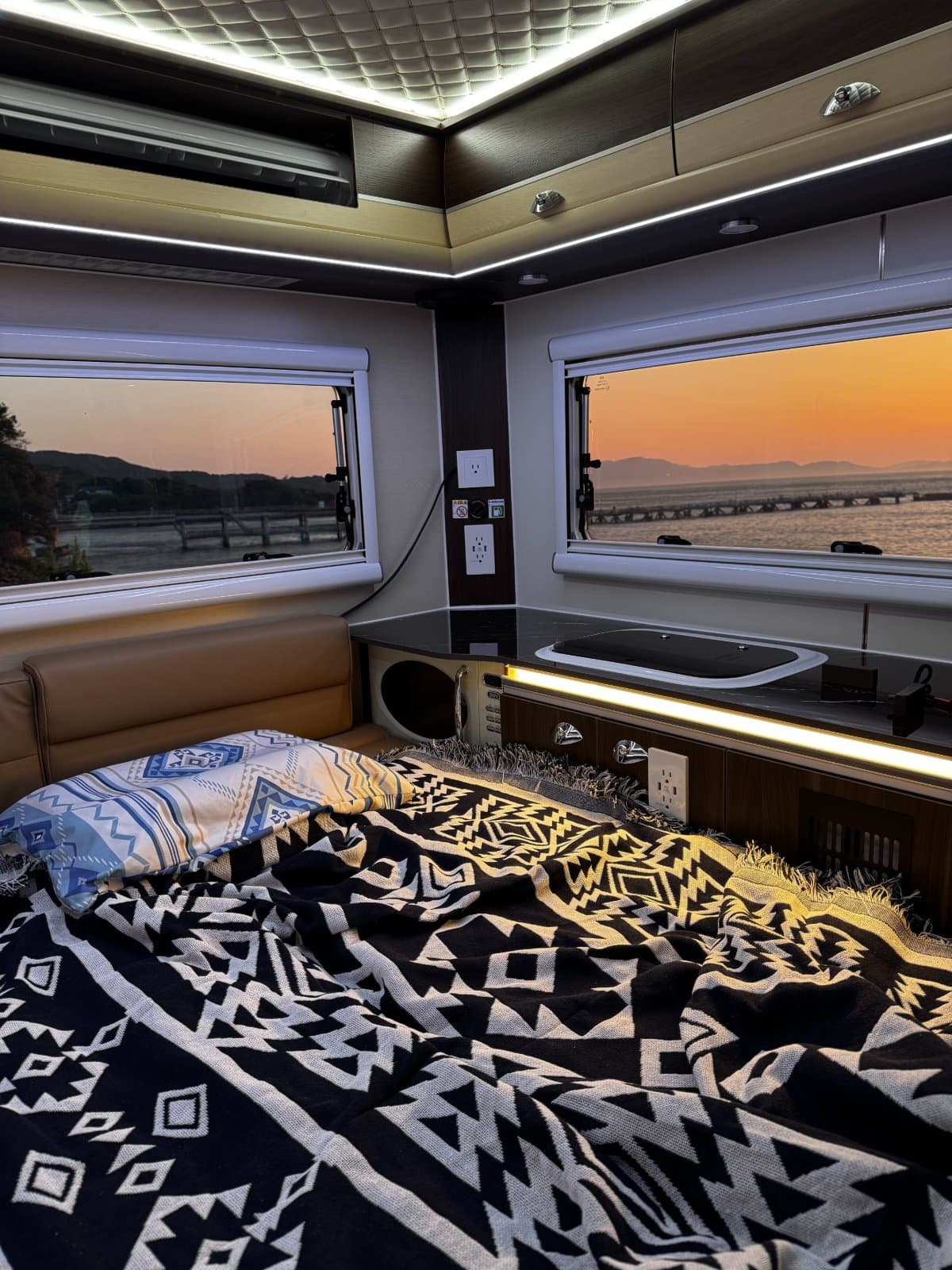
There is a fridge on board, so meat, vegetables, milk and baby food stay cold from the moment you leave until the next day. A 400 Ah (5,120 Wh) lithium battery and a 3,000 W inverter run the air-conditioning with the engine off, charge phones and boil an electric kettle. When a child flags on a hot afternoon, one adult can settle them on the bed inside with the air-conditioning on. The van is parked right beside the pitch, so they are a few steps from the grill and within earshot of everyone else.
The biggest difference is that nobody has to drive back to a hotel. Stay at an auto campsite and you sleep where you ate, so the adults who had a drink are not behind the wheel (anyone who drank should not drive the next morning until the alcohol has fully cleared). And the day starts whenever the children wake up.
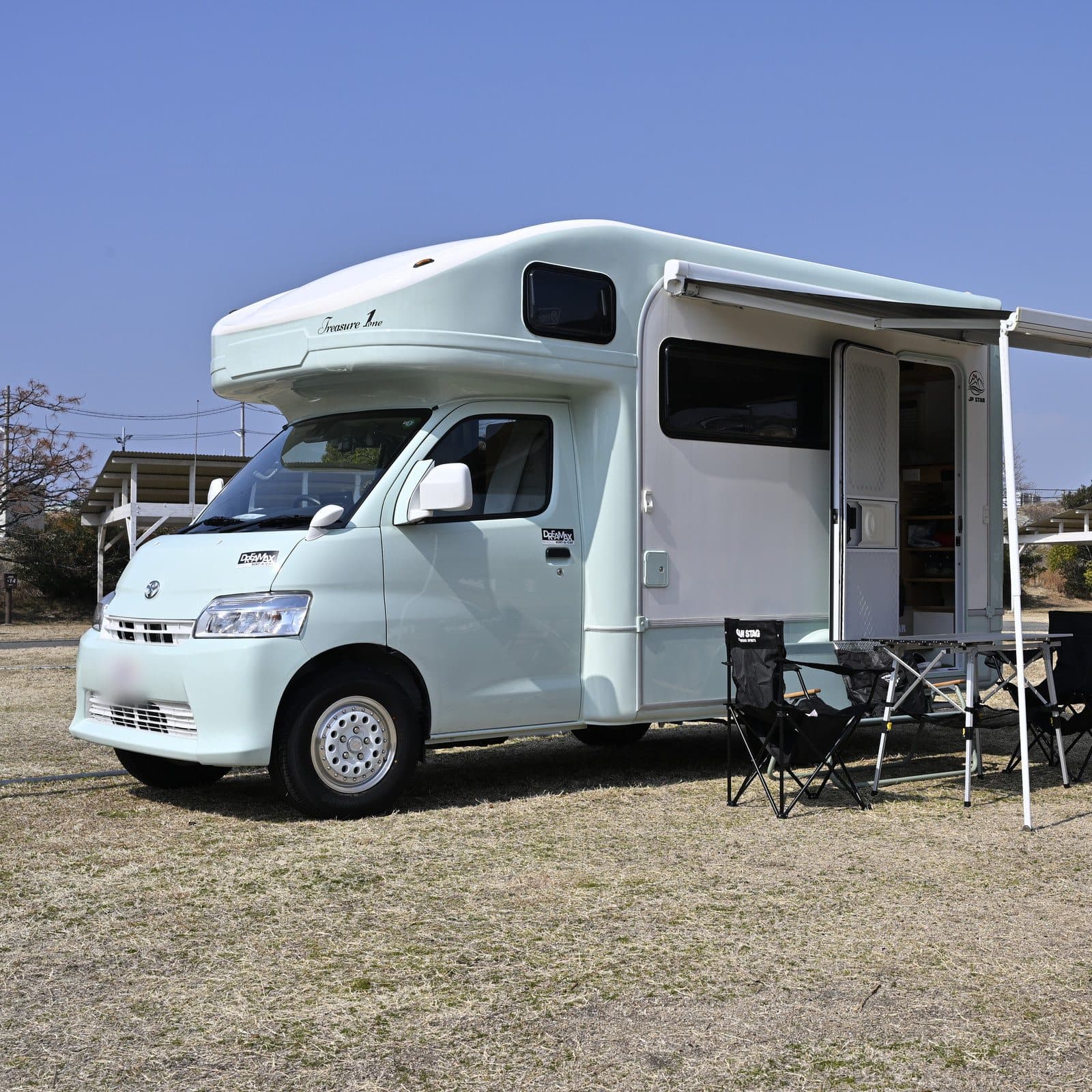
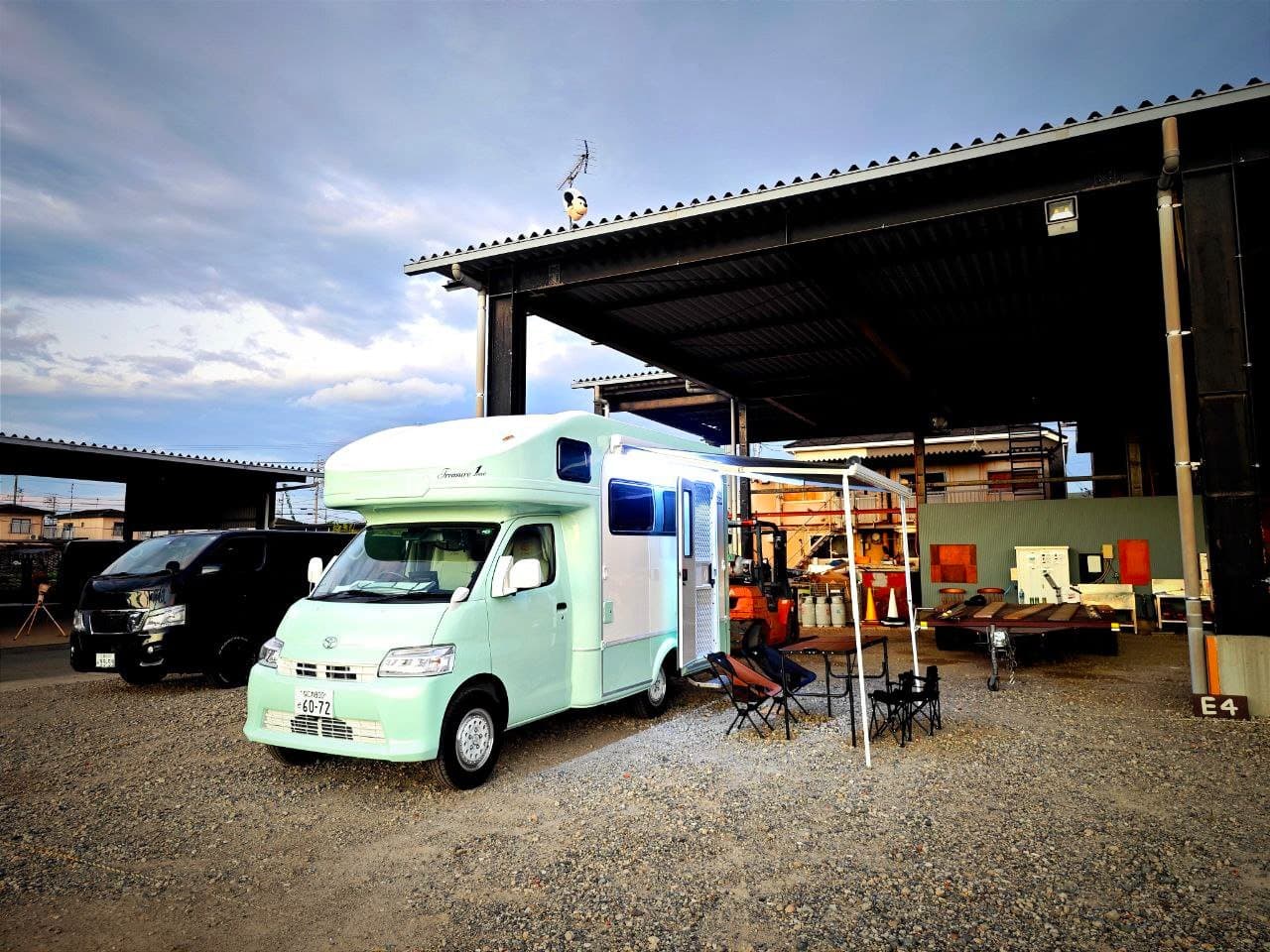
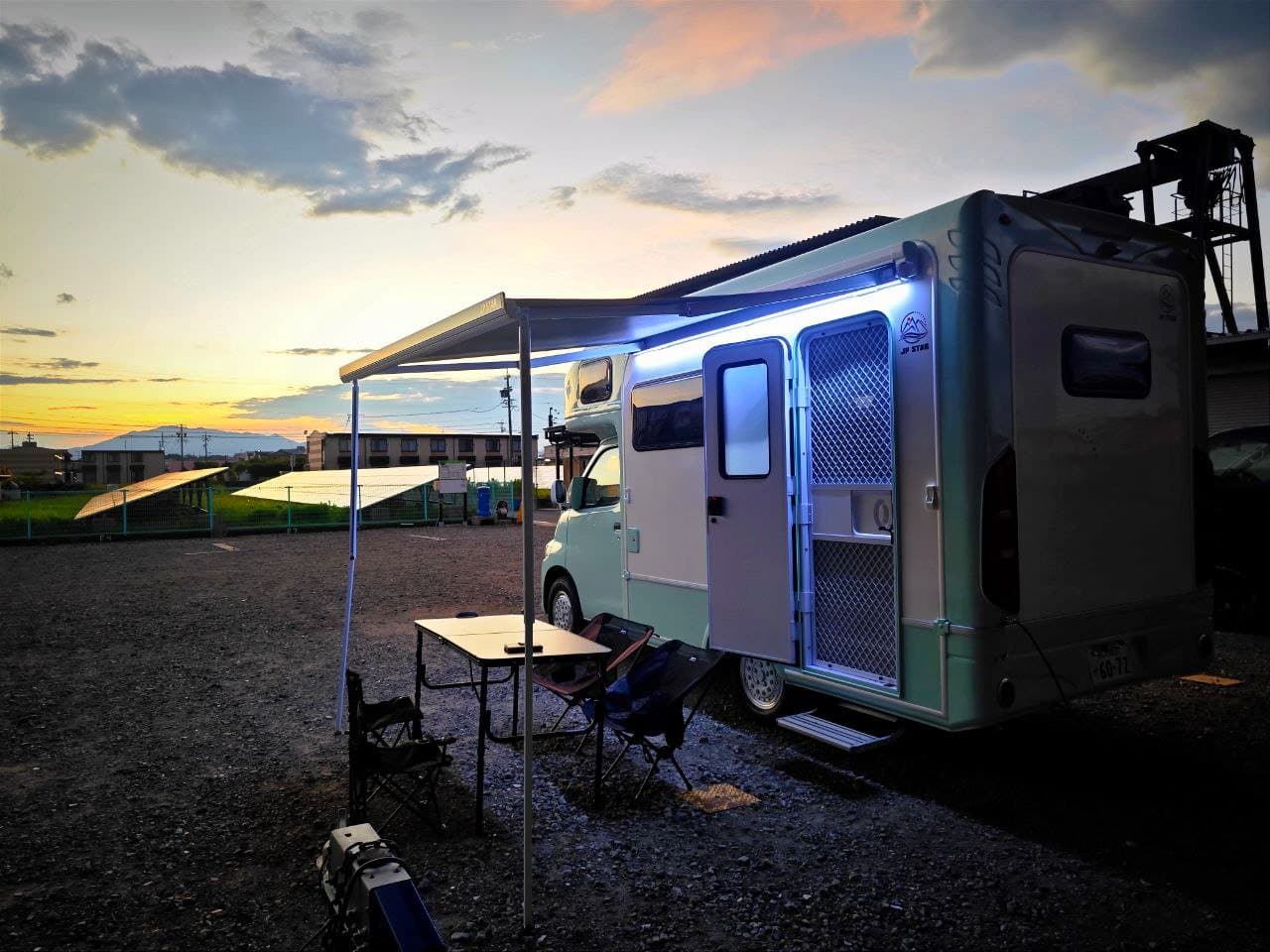
Both campers have a powered awning that turns the space beside the van into a shaded dining room. Both also have an outdoor shower (fed by a 60-litre fresh-water tank on the Treasure 1) for rinsing feet and sand, not for bathing, so sooty, sandy feet get rinsed before anyone climbs back in.
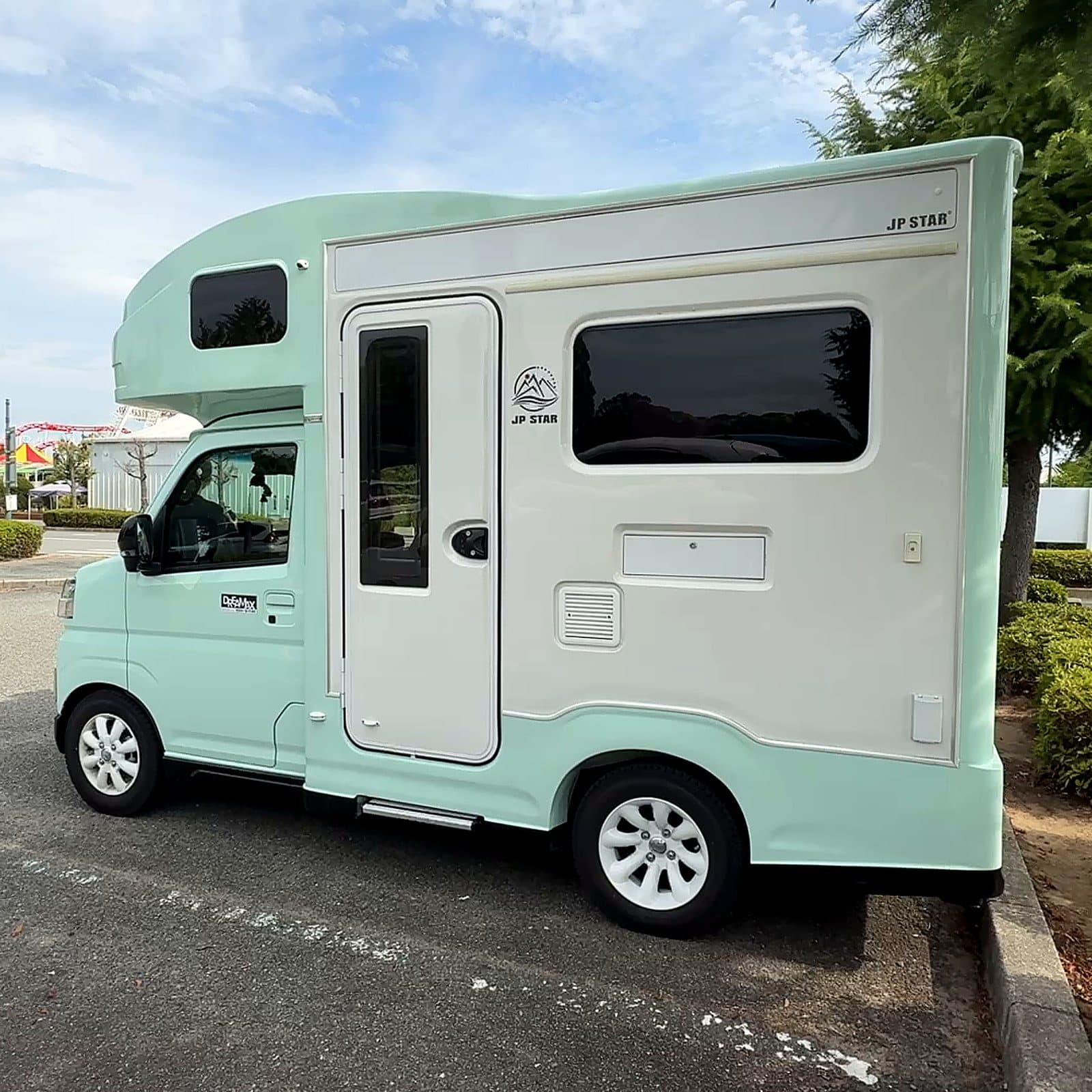
- Happy 1 Turbo: seats 4, sleeps 4 adults, a 3,880 mm kei-class camper. Fridge, microwave, sink, an FF heater (fuel-fired) plus floor heating (two heating systems), an outdoor shower and a 360-degree around-view monitor.
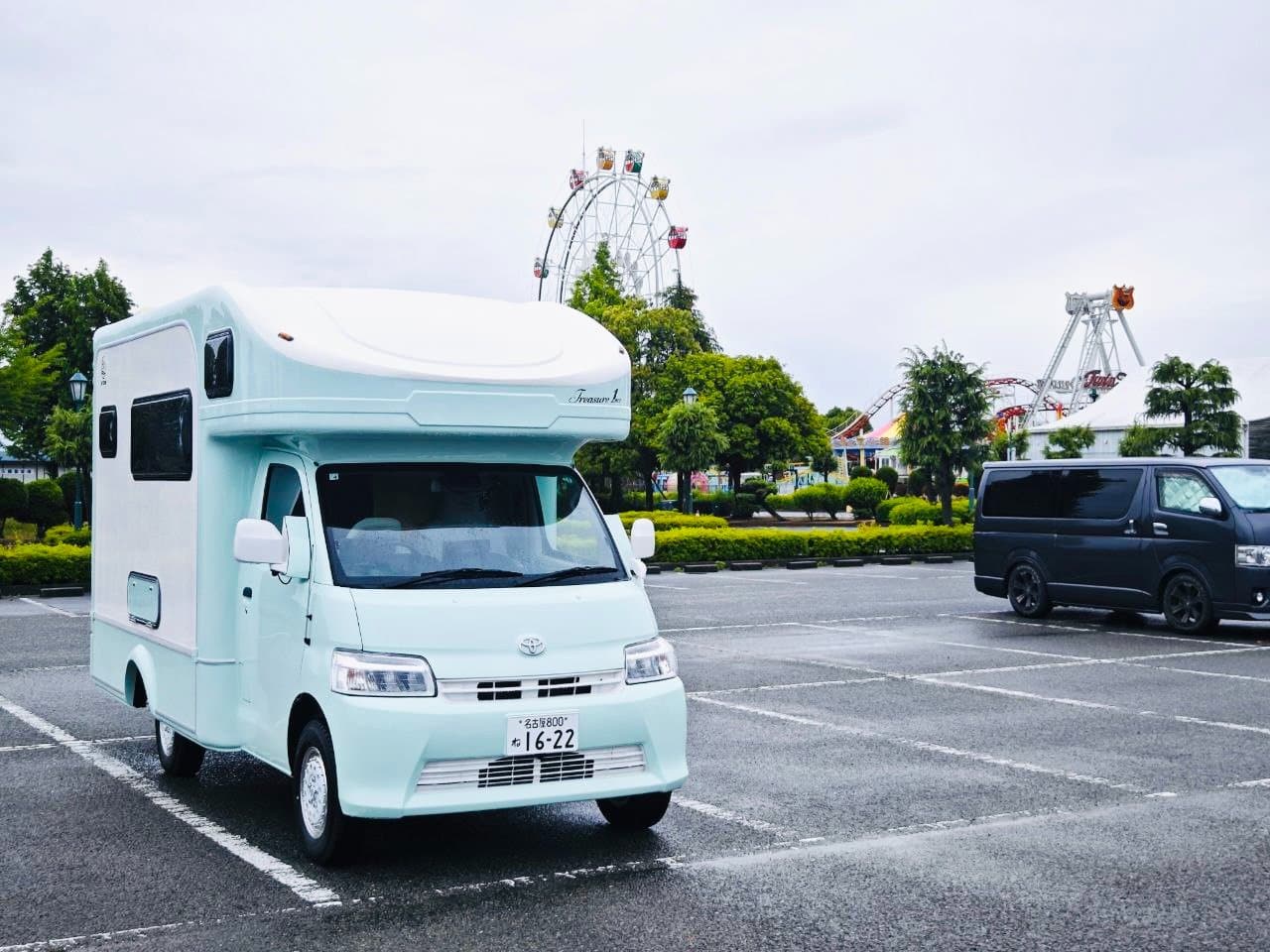
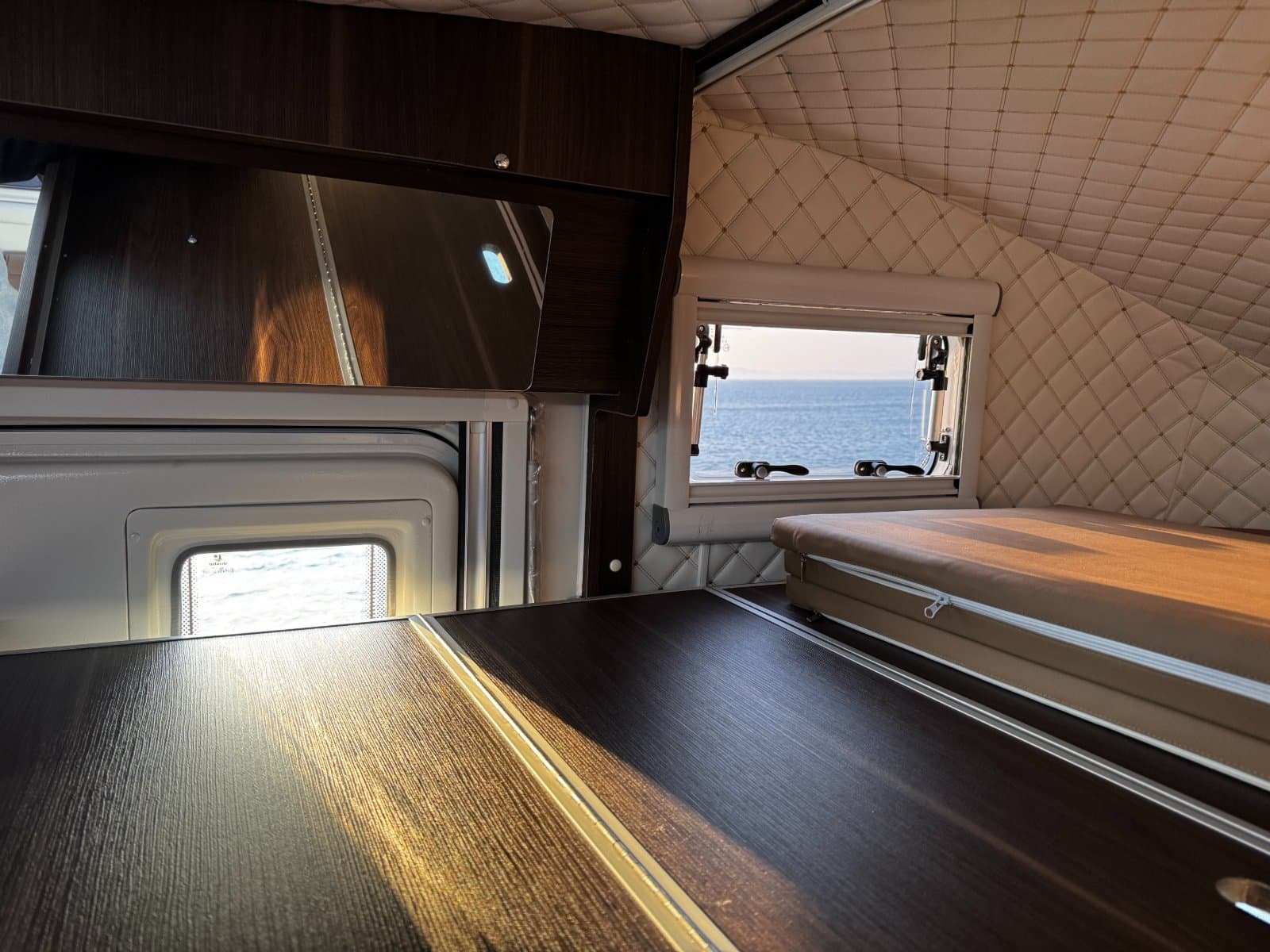
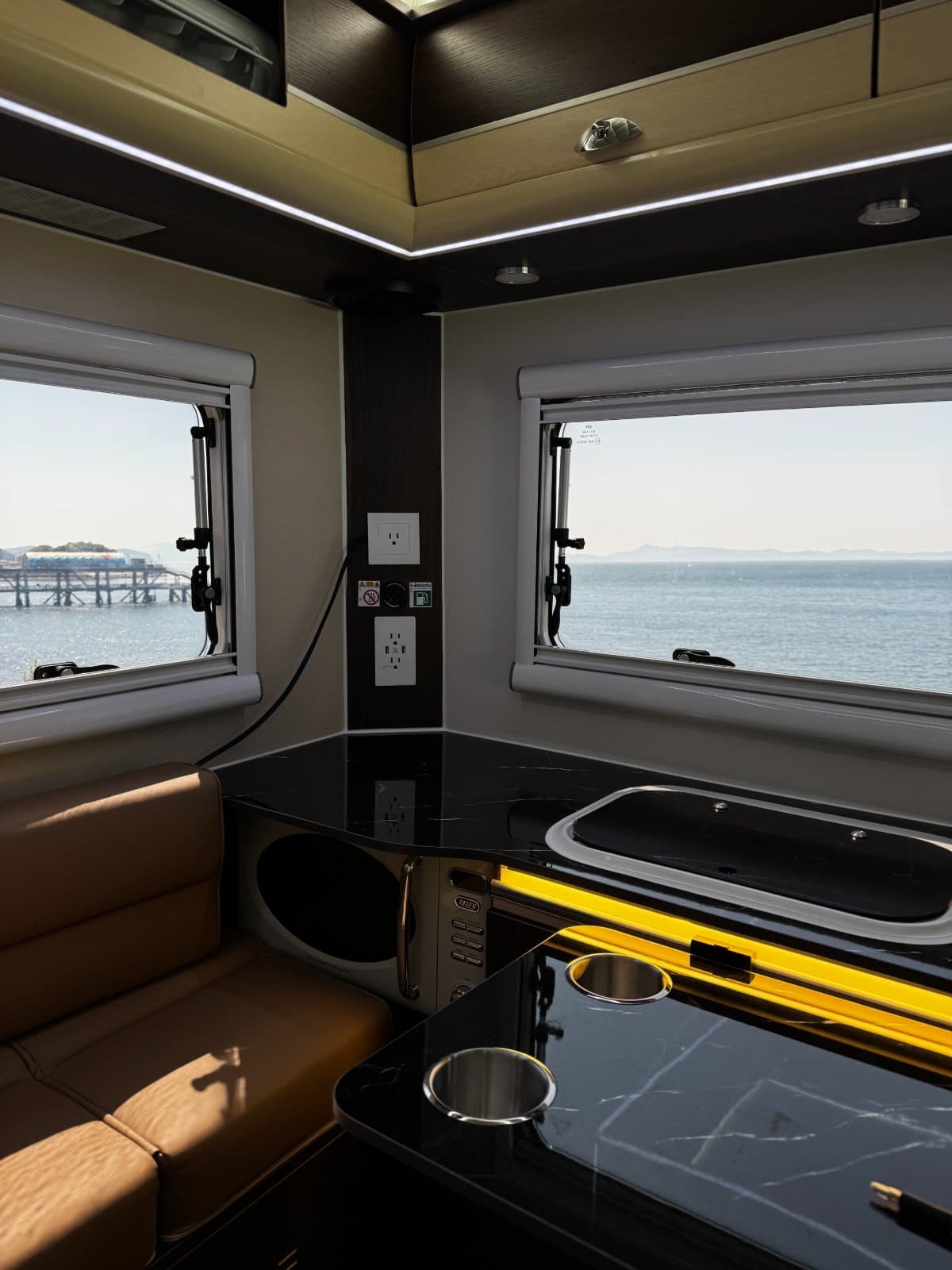
- Treasure 1: seats 6 (4 adults + 2 children), sleeps 4 adults + 2 children, a 4,900 mm family cab-over camper. IH cooktop, extractor fan, microwave, fridge, sink, an FF heater (fuel-fired) plus household air-con heating (two heating systems) and an outdoor shower.
- Both: a 400 Ah (5,120 Wh) lithium battery, a 3,000 W inverter, air-conditioning and heating, and a powered awning.
What to rent from DREAMAX, and what it costs (per trip, tax excluded)
All equipment is priced per trip, not per day, so the price is the same for one night or two. Tick what you need under add-on equipment when you book and it is handed over with the van. Prices are shown before tax; 10% consumption tax is added at payment.
For a family of four on a one-night BBQ, three items cover almost everything: the BBQ grill set, the table and chair set and the 15-litre cooler, ¥14,000 before tax in total. Meat and vegetables go in the van's own fridge, drinks in the cooler. Add the blackout tarp in midsummer, and the 39-litre car fridge if you are staying two nights or more with plenty of frozen food or ice.
The grill set comes with a grill net, charcoal tongs and other basic accessories. Charcoal and firelighters are easy to buy at supermarkets, home centres and campsite shops. After use, empty the ash and clean the grill before you return it.
The Iwatani cassette stove is the quick option for noodles, soup and the morning kettle. Use it to feed the children first while the charcoal gets going, or switch to it when rain rules out the grill. The Treasure 1 has an IH cooktop, which is plenty for simple cooking inside.
- Outdoor BBQ grill set: ¥6,000 (grill net, charcoal tongs and basic accessories)
- Iwatani cassette stove with 3 gas canisters: ¥6,000
- Outdoor table and chair set: ¥6,000
- BougeRV Rocky 39L car fridge (independent fridge and freezer zones): ¥6,000
- Coleman 15L cooler with ice pack: ¥2,000
- Coleman Darkroom tarp (3 m × 3 m, blocks 90%+ of light): ¥6,000
- Basic cooking set (bowls, chopsticks, spoons and cups for 4): free
- Infant seat (ages 0 to 4) and booster seat (ages 4 to 10): free
- ETC card: free (tolls settled on return)
Where you can and cannot barbecue in Japan
The first thing to know about camper travel in Japan is that a place where you may sleep in the vehicle and a place where you may barbecue are not the same thing. Roadside stations (michi-no-eki) and expressway service and parking areas (SA/PA) exist so drivers can rest. Resting and sleeping inside the vehicle is fine; barbecuing, cooking, putting chairs and a table outside or opening the awning is not. Using a stove on the car-park tarmac is out too.
You can barbecue at auto campsites, BBQ grounds, and RV parks or campsite areas that allow fire. RV parks exist for overnight parking and their rules on fire and barbecues vary a great deal, so when you book, ask directly whether a charcoal grill is allowed. Parks and riverbanks are similar: some ban barbecues outright and some allow them only in designated areas, so follow the signs and the local rules.
Most campsites ban open fires on the ground (jikabi kinshi). The rule is about lighting a fire directly on the earth; using a grill or a fire stand is generally fine, and that is how charcoal barbecues are done at most sites. The DREAMAX grill set works this way, so you can use it wherever a site allows grills. Follow the site's rules on details such as a heat-resistant mat underneath.
Used charcoal goes only into the campsite's ash disposal point. Do not bury it, and do not douse it and leave it. Charcoal that looks dead stays hot for a long time: put it out completely in a fire-extinguishing pot or a bucket of water, then take it to the right place. Sort your rubbish and take it home, or dispose of it as the site directs.
There is a line inside the van too. Boiling water or simple cooking on the Iwatani cassette stove is fine inside with the windows and skylight open for ventilation. Charcoal, on the other hand, must never come inside: even when it seems to be out it keeps giving off carbon monoxide, which can kill in a closed vehicle. Do not grill directly under the awning either, as heat and sparks damage the fabric.
- Roadside stations and SA/PA: rest and sleep in the vehicle only. No BBQ, no cooking, no chairs or tables outside, no awning.
- Auto campsites and BBQ grounds: BBQ allowed (use a grill where open fires are banned). Check the rules when you book.
- RV parks: built for overnight parking. Ask about fire and BBQ at each one.
- Charcoal and ash go to the ash disposal point. Sort rubbish and take it home or follow the site rules.
- No charcoal inside the van. The cassette stove is for simple cooking with ventilation.
Weekend plans from Osaka: one night on Awaji, two nights at Lake Biwa
For a first trip, one rule prevents most problems: on the night you barbecue, stay at an auto campsite. Here are two plans to places a little over an hour from Osaka, Awaji Island for one night and Lake Biwa for two. Campsites fill up fast on popular weekends, so book your pitch at the same time as the camper.
Awaji Island, one night. On day one, collect the van in the morning in Osaka city or at Kansai Airport and take the Hanshin Expressway onto the Kobe-Awaji-Naruto Expressway. Awaji interchange is about an hour away across the Akashi Kaikyo Bridge, and Michi-no-eki Awaji, right under the bridge, about ten minutes further. Have a raw whitebait (nama-shirasu) bowl for lunch, let the children run through the flower fields at Awaji Hanasajiki, then head south: about 30 minutes from the north of the island to Sumoto, and another 30 to Fukura. Check in to an auto campsite in the Minami-Awaji area before dusk, open the awning, set up the table and grill Awaji beef and Awaji Island onions.
On day two, spend the morning at a nearby roadside station's farm stand buying onions and local vegetables to take home. If there is time, take a whirlpool cruise from Fukura port (the whirlpools are most dramatic around spring tides; check sailings before you go). Drive north along the west coast to Awaji interchange, about an hour, then about an hour to Osaka. The approach to the Akashi Kaikyo Bridge gets busy on Sunday evenings, so leaving Minami-Awaji around 3 pm keeps the return relaxed.
Lake Biwa, two nights. Collect the van in Osaka on Friday evening and head north on the Meishin Expressway and the Kosei road. Spend the first night at Michi-no-eki Imoko-no-Sato in Wani, Otsu, which has 24-hour toilets and a convenience store. It is a rest-only night: no barbecue at a roadside station. On Saturday morning follow the shore north to Shirahige Shrine in Takashima (about 1 hour 30 minutes from Osaka), then about 40 minutes further to the Metasequoia avenue at Makino. For the second night, book a lakeside auto campsite with power on the west shore: paddle in the shallows in the afternoon and barbecue as the sun sets over the lake.
On Sunday morning, drive about 40 minutes to Michi-no-eki Kohoku Mizudori Station on the north shore, which has a local produce stand and a car park facing the lake. Walk around Kurokabe Square in Nagahama, stop at Hikone Castle, and take the expressway home: about 2.5 to 3 hours in total from the north shore via Hikone. Traffic builds around Kyoto on Sunday afternoons, so set off early.
Both plans follow the same pattern: an auto campsite on the barbecue night, a roadside station or service area on a rest-only night, and a roadside-station farm stand in the morning. Once that rhythm feels natural it works anywhere. The Wakayama coast has plenty of family-friendly auto campsites and RV parks too.
- Awaji, 1 night: Osaka → Awaji IC about 1 h → Michi-no-eki Awaji about 10 min → Sumoto about 30 min → Fukura about 30 min (auto campsite, BBQ) → west coast → Awaji IC about 1 h → Osaka about 1 h
- Lake Biwa, 2 nights: Osaka → Michi-no-eki Imoko-no-Sato (rest night) → Shirahige Shrine (about 1 h 30 from Osaka) → Metasequoia avenue about 40 min (lakeside auto campsite, BBQ) → Kohoku Mizudori Station about 40 min → Hikone about 40 min → Osaka about 2 h
Keeping children safe and comfortable
Child seats are free. Japanese road law requires a child restraint for every child under six, and that applies in a campervan as in any car. Choose the number you need when booking: an ISOFIX infant seat for ages 0 to 4 (about 9 to 18 kg) and a seatbelt-secured booster for ages 4 to 10 (about 15 to 36 kg). They are fitted before handover, and DREAMAX staff show you how to remove and refit them. While the van is moving, everyone sits in a seat with the belt fastened.
The most common barbecue injury is a burn. Mark out an area around the grill that children do not enter, and give one adult the job of minding the fire. Charcoal stays hot long after it looks dead, so an adult should handle it until it reaches the ash disposal point. A bucket of water beside the grill is cheap peace of mind.
In summer, shade and water are everything. Make shade with the powered awning or the tarp, and keep the children drinking. The camper's air-conditioning runs from the battery with the engine off, so breaks can be taken inside. But never leave a child alone in the vehicle, however briefly.
For insects the basics are enough: repellent spray, long sleeves and trousers, and a mosquito coil in the evening. The Treasure 1 has insect screens on its windows and door, so you can let the breeze in and keep the bugs out. By the water, an adult stays right beside the children even in the shallows, and a child's life jacket adds a margin of safety.
At most campsites, quiet hours begin somewhere around 9 or 10 pm. Once the children are asleep, dim the lights and keep the TV and music low. Because the camper's heating and cooling run from the FF heater and the battery, you do not need to idle the engine or run a generator, so you can sleep comfortably without disturbing the next pitch. Children wake early, so keep early-morning voices down as well.
- Infant seat (ages 0 to 4, about 9 to 18 kg, ISOFIX): free
- Booster seat (ages 4 to 10, about 15 to 36 kg, seatbelt-secured): free
- A no-go zone around the grill, and one adult on fire duty
- Shade, water and breaks in the air-conditioned van on hot days; never leave a child alone inside
For first-timers: handover, four-language support, and a routes and spots database
If you have never driven a camper, DREAMAX staff go through the vehicle and your equipment item by item at handover: making up the beds, reading the power panel, filling and draining water, fitting the child seats and using the add-ons you booked. Allow about an hour. Both campers are automatic and can be driven on a standard car licence (AT). The Happy 1 Turbo, a 3,880 mm kei camper, is particularly easy to handle on a first drive.
Handover and return are free in Osaka city and at Kansai International Airport; you only pay the tolls and fuel for that leg. There is no minimum rental length, so one night is fine. Book by 12:00 Japan time and you can collect as early as the next day, which means you can wait for a good weekend forecast before deciding to go.
If anything comes up on the road, message us on WhatsApp or LINE between 08:00 and 20:00 Japan time. Support covers four languages: Japanese, English, Cantonese and Mandarin. Small questions are welcome, whether it is how to plug into campsite power or how to refit a child seat.
To choose where to sleep and where to barbecue, use the DREAMAX Connect database of places. As of September 2026 it lists 3,990+ overnight-capable stops, meaning roadside stations, SA/PA, RV parks and auto campsites (566 of them in Kansai), and 7,900+ places in all once sightseeing stops are included. Of the overnight stops, 1,296 are auto campsites and 672 are RV parks. Every fact carries its official source and the date it was retrieved, so from each spot page you can follow the link to the official site and confirm its rules on fire and barbecues.
DREAMAX Connect also publishes 53 campervan routes of 1 to 7 days, 31 of them starting in Osaka (as of September 2026). Once Awaji and Lake Biwa feel familiar, try the Wakayama coast or a longer trip next.
Campers for this trip
FAQ
Is a BBQ set included?
Not in the vehicle rate; it is an add-on. The BBQ grill set is ¥6,000 per trip before tax, the same for one night or two, and comes with a grill net, charcoal tongs and other basics. The basic cooking set with tableware for four and child seats are free; the table and chair set is ¥6,000 and the 15-litre cooler ¥2,000 (all before tax, per trip).
Can we barbecue at a roadside station (michi-no-eki)?
No. Roadside stations and expressway SA/PA are rest facilities. You may rest and sleep inside the vehicle, but barbecuing, cooking and putting chairs or a table outside are not allowed. Barbecue at auto campsites, BBQ grounds and other places that permit fire.
What if it rains?
Both campers have a powered awning you can sit under in light rain, but do not use a charcoal grill directly under it. Choose a campsite with a roofed cooking or BBQ area, use the cassette stove inside with ventilation, or cook on the Treasure 1's IH cooktop. You can also switch between Awaji and Lake Biwa at the last minute; check each campsite's own cancellation terms. The Lake Biwa Museum is a good rainy-day stop.
From what age can children come?
There is no minimum age. Japanese law requires a child seat under six, and DREAMAX lends an infant seat for ages 0 to 4 (about 9 to 18 kg) and a booster for ages 4 to 10 (about 15 to 36 kg) free of charge. If your baby weighs less than 9 kg, please contact us before booking. A family of five or six with children fits the Treasure 1 (seats 6: 4 adults + 2 children); up to four, the Happy 1 Turbo.
What do we do with rubbish and charcoal?
Sort rubbish and put it out as the campsite directs, or take it home. Charcoal and ash always go to the campsite's ash disposal point. Never bury them, and never put them in bins at roadside stations or SA/PA; roadside-station bins are for things bought in the shop. Empty and clean the grill before returning it, and pack a few extra rubbish bags.
Related guides
Looking for more? All car-camping spots in Japan · Driving route library
Choose your BBQ gear and book the family weekend
See campers and rates