
2027 Cherry Blossom Drive
2027 Kansai Cherry Blossoms by Campervan: A 5-Day Route from Osaka
Kansai's cherry blossoms take about a month to travel from Kyoto in late March to the upper slopes of Mount Yoshino in late April. A DREAMAX campervan lets you follow them in that order: Arashiyama at first light, Kaizu-Osaki on the north shore of Lake Biwa in the afternoon, and Mount Yoshino to finish. This is a 5-day, 4-night loop from Osaka, with a named overnight stop for each night and a link to every spot's official page. Every bloom window here is a typical-year guide. Once the 2027 forecasts are published, the bloom meter at the top of this page is updated every week.
By Gary, campervan & car-camping advisor at DREAMAX
Bloom meter (updated weekly from March 2027)
From March 2027 this section is updated every week. For each of the five spots on the route it will show that week's state of bloom, with the date it was checked. The typical-year calendar just below is the long-run guide; this is the live picture for the year.
As of 27 November 2026, no bloom forecasts for 2027 have been published, so every line below reads "updated once bloom forecasts are published". When the updates start, they will follow the official announcements of the venues, the municipalities and their tourism associations.
- Daigoji | Updated once bloom forecasts are published (usually best from late March to early April)
- Arashiyama | Updated once bloom forecasts are published (usually best in early April)
- Kaizu-Osaki | Updated once bloom forecasts are published (in recent years best around early April)
- Mount Yoshino, Shimo-senbon | Updated once bloom forecasts are published (usually blooms early to mid April)
- Mount Yoshino, Oku-senbon | Updated once bloom forecasts are published (usually blooms mid to late April)
The typical-year bloom calendar, and when to set off
Cherry blossoms open at different times depending on altitude and latitude. According to the Kyoto City Tourism Association, Daigoji is usually at its best from late March to early April and Arashiyama in early April. Kaizu-Osaki, on the north shore of Lake Biwa, has in recent years been at its best around early April, according to the Biwako Takashima Tourism Association, and is often about a week later than central Kyoto. On Mount Yoshino, the Nara Prefecture official tourism site gives early to mid April for Shimo-senbon, the lowest slopes, and mid to late April for Oku-senbon at the top: the blossom climbs the mountain over several weeks.
The five days are planned for a departure in the first week of April in a typical year. The two Kyoto spots come first, Kaizu-Osaki on day 2, and Mount Yoshino last. The later a place usually blooms, the further back it sits in the route, so if the season runs a few days early or late, the order is easy to rearrange. When the forecasts come out in March, set off a few days earlier in an early year, or a few days later in a late one.
Every overnight stop is a real roadside station (michi-no-eki) or RV park, and each one is in DREAMAX's car-camping database, Dreamax Connect. The links under each day open its map entry, its facilities and its official listing.
- Daigoji (Fushimi, Kyoto): late March to early April
- Arashiyama (Ukyo, Kyoto): early April
- Kaizu-Osaki (Takashima, Shiga): around early April in recent years, often about a week after central Kyoto
- Mount Yoshino, Shimo-senbon (Yoshino, Nara): early to mid April
- Mount Yoshino, Oku-senbon: mid to late April
- Japan Mint cherry-blossom passage (Kita, Osaka): one week each year, usually in early to mid April
- Daigoji cherry blossoms (Kyoto City Tourism Association, Japanese)
- Arashiyama cherry blossoms (Kyoto City Tourism Association, Japanese)
- Kaizu-Osaki cherry blossoms (Biwako Takashima Tourism Association, Japanese)
- Mount Yoshino, Shimo-senbon (Nara official tourism site, Japanese)
- Mount Yoshino, Oku-senbon (Nara official tourism site, Japanese)
- Cherry-blossom passage (Japan Mint, Japanese)
Day 1: Osaka → Daigoji → Kameoka
Collect the van in central Osaka or at Kansai Airport and take the expressway to Daigoji in Fushimi, Kyoto: about an hour from central Osaka. Daigoji is a large temple whose sights are spread across separate precincts, the Sanboin, the main temple grounds and the Reihokan museum, and its weeping cherries and Somei-yoshino trees open at slightly different times. It is usually at its best from late March to early April.
The temple's own access page explains the parking: general vehicles use the south car park (142 spaces), and large vehicles and tour buses the north car park. It also warns that general vehicles parked in the north car park pay a higher rate, so follow the signs. On cherry-season weekends, arriving early is the safe plan.
In the afternoon drive on to Kameoka, about an hour. Spend the night at the roadside station Galleria Kameoka. According to the National Michi-no-Eki Association, part of its car park (58 car spaces and 5 large-vehicle spaces) is open 24 hours, and it has tourist information and a shop. Arashiyama is about 30 minutes away, which makes it a good place to sleep before an early start.
- Practical tip: Daigoji's sights cover a wide area. Decide which ones you want to see and plan the walking order before you arrive, and you will not lose time.
Day 2: Kameoka → Arashiyama → Kaizu-Osaki (Makino, Takashima)
Arashiyama is about 30 minutes from Kameoka. It is usually at its best in early April, and by late morning the area around the Togetsukyo bridge is packed. At 7 am the bridge and the riverbank are quiet enough to feel like a different place. We do not recommend driving a campervan deep into central Arashiyama: the roads are narrow, most car parks are built for cars, and Treasure 1 (2.8 m tall) will not fit a multi-storey car park. Park in an open-air car park early, walk, and leave before the crowds build. That is the practical way to do it.
Leave Arashiyama before noon and take the Meishin expressway and the Kosei road to Kaizu-Osaki in Makino, Takashima, on the north shore of Lake Biwa: about two hours. Here a line of cherry trees follows the lakeshore road, and the Biwako Takashima Tourism Association says it has been at its best around early April in recent years. There is no dedicated car park nearby; the association points visitors to the free car park at JR Makino Station. From the station it is about an hour on foot, or about six minutes by community bus.
In a typical year, traffic controls run during the day on the two weekend days at the height of the bloom, for example one-way traffic on the lakeshore prefectural road. The tourism association publishes the dates and sections each year. A weekday afternoon, or any day outside the controls, is much easier. For the night, go to the roadside station Makino Oisaka-toge. The tourism association's own listing introduces it with the Kaizu-Osaki cherry blossoms in spring, and it has 40 large-vehicle spaces. If you would rather spend a proper camping night, choose the nearby RV park Relacping Metasequoia (booking required).
- Practical tip: Arashiyama early, Kaizu-Osaki in the afternoon. A Kyoto morning and a Lake Biwa afternoon give you two famous spots in one day, both outside the busiest hours.
- Kaizu-Osaki access and parking (Biwako Takashima Tourism Association, Japanese)
- Kaizu-Osaki traffic controls (Biwako Takashima Tourism Association, Japanese)
- Michi-no-eki Makino Oisaka-toge (National Michi-no-Eki Association, Japanese)
- Makino Oisaka-toge: map and facilities
- RV park Relacping Metasequoia (official, Japanese)
- Relacping Metasequoia: map and facilities
Day 3: Makino → Nara → Yoshino (Oyodo)
Day 3 is a driving day. Head south on the Kosei road in the morning, then the Meishin expressway and the Keiji bypass into Nara Prefecture. Oyodo, the gateway to Yoshino, is about three hours away. If you want to stop for lunch in Nara city on the way, leave early so that you reach Yoshino in the early afternoon.
Spend the night at the roadside station Yoshinoji Oyodo i-Center. It has a shop, a restaurant and tourist information; the facilities are open 8:30 to 17:00 (closed Tuesdays, varying with the season). The Mount Yoshino car parks are about 20 minutes away, so it suits the night before an early climb. If you would like a hot spring and an RV park instead, choose RV Park Lite Kamokimi no Yu in Gose (book online), an RV park in the car park of a day-use hot spring.
On a long driving day, the rule is a break every two hours. Stop at the service and parking areas on the Meishin or Nishi-Meihan expressways, and if you feel sleepy, do not push on: rest in the van.
- Practical tip: on cherry-season weekends the Mount Yoshino car parks fill early. Sleep in Oyodo and you can be up the mountain first thing.
Day 4: Mount Yoshino → Kawakami
Mount Yoshino blooms from the bottom up, in the order Shimo-senbon, Naka-senbon, Kami-senbon and Oku-senbon. The Nara Prefecture official tourism site gives the usual blooming period as early to mid April for Shimo-senbon and mid to late April for Oku-senbon. On this route's dates the lower and middle slopes are often in full bloom; in an early year walk higher, in a late year enjoy the lower slopes.
The Yoshinoyama Tourism Association lists the car parks on its website: the Yoshinoyama Kanko car park (about 400 cars) and the Nyoirinji car park (about 200 cars) are open all year, and further car parks open only in the cherry season. During the season there are traffic controls, mainly at weekends, so check the association's and Yoshino town's pages the week before you go. Once parked, walk up the old temple-town street to the Zao-do hall of Kinpusenji. If your legs are up to it, carry on to Yoshimizu Shrine or the upper slopes of Kami-senbon. The ropeway's service varies with the season.
In the evening drive south on National Route 169 for about 30 minutes to the roadside station Sugi no Yu Kawakami. According to the National Michi-no-Eki Association, the adjoining Hotel Sugi no Yu offers day-use hot-spring bathing. Warm up legs that have walked all day, then rest in the van until morning.
- Practical tip: Mount Yoshino is quietest in the morning. Reach the car park early and start walking up from Shimo-senbon before the crowds arrive.
Day 5: Kawakami → Osaka (and the Mint's cherry-blossom passage)
On the last day head back north on Route 169: about two hours to central Osaka, and roughly the same to return at Kansai Airport. Handover at Kansai Airport and in central Osaka is free.
If the dates line up, take the train to the Japan Mint's cherry-blossom passage after you return the van. Each year, in the cherry season in early to mid April, the Mint in Kita, Osaka, opens a path of about 560 m along the old Yodo river inside its grounds for one week. In recent years it has been held with advance reservations. The Mint announces the dates and how to book each year, so check before you fix your trip dates.
The five days cover about 500 km. An ETC card is lent free of charge, and tolls are settled when you return the van.
- Practical tip: return in the early afternoon. Rather than packing the last day with detours, get back to Osaka before the traffic, and the trip ends without a rush.
Nights: roadside stations and RV parks
Roadside stations (michi-no-eki) are registered under a scheme run by the Ministry of Land, Infrastructure, Transport and Tourism, and one of the conditions is that the car park and toilets are free to use 24 hours a day. If you are tired, sleep in the van: resting there until morning is fine unless a sign says otherwise, because a rested driver is a safe one.
But a roadside station is a rest facility. Do not set out chairs or tables, open the awning or cook outside. On nights when you want to eat outdoors or plug in, choose an RV park or an auto campground; on this route, Relacping Metasequoia on day 2 and Kamokimi no Yu on day 3 are those options.
On the road, help is available in four languages (Japanese, English, Cantonese and Mandarin) on WhatsApp and LINE, 08:00–20:00 Japan time every day. If you pull into a roadside station and find it full, message DREAMAX there and then: we search our database of 3,990+ overnight-capable stops (as of September 2026) for the nearest alternative and send it to you.
Parking in cherry season: think in van sizes
Most car parks at cherry-blossom spots are built for cars, so your tactics depend on the size of the van. The figures below come from the same data as the car pages.
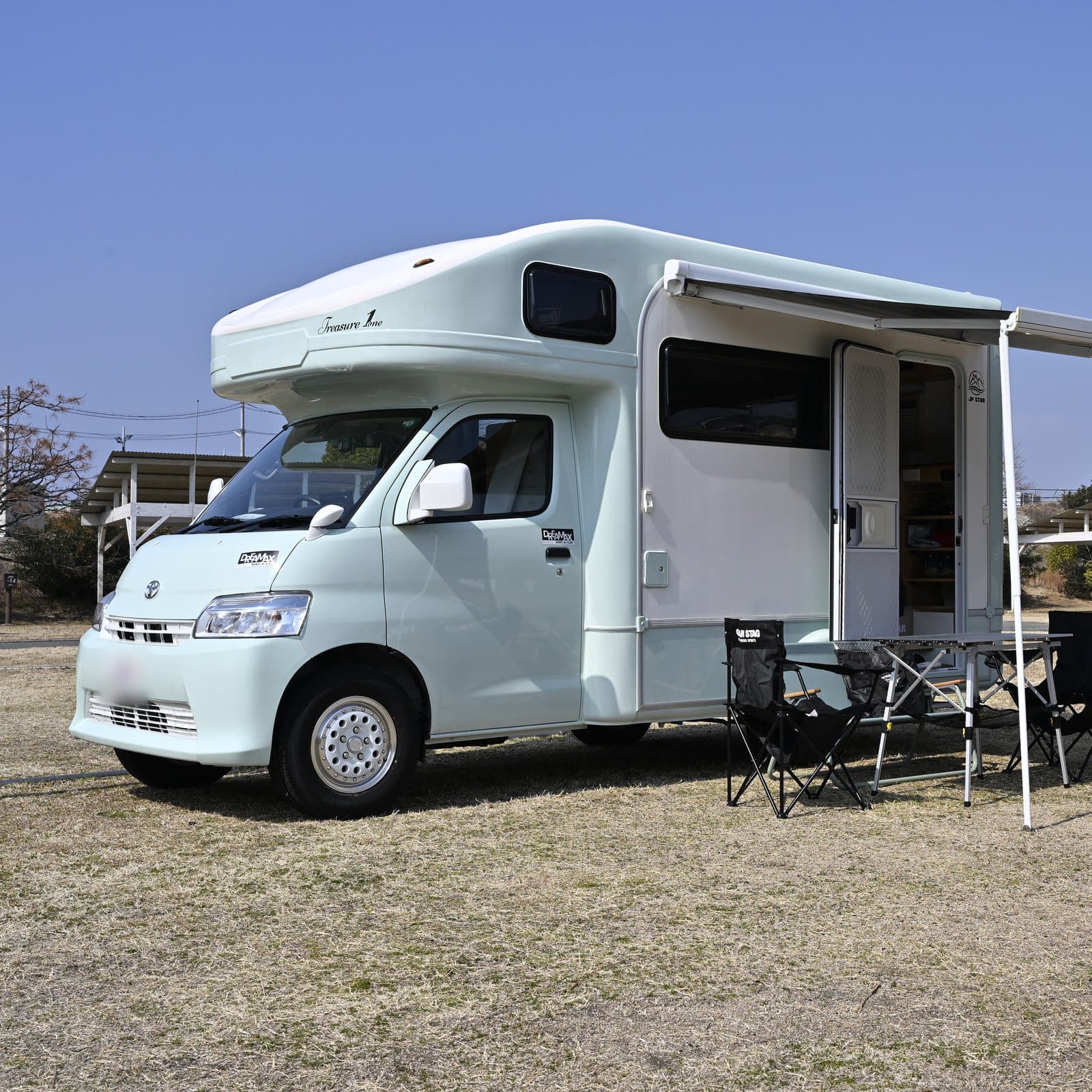
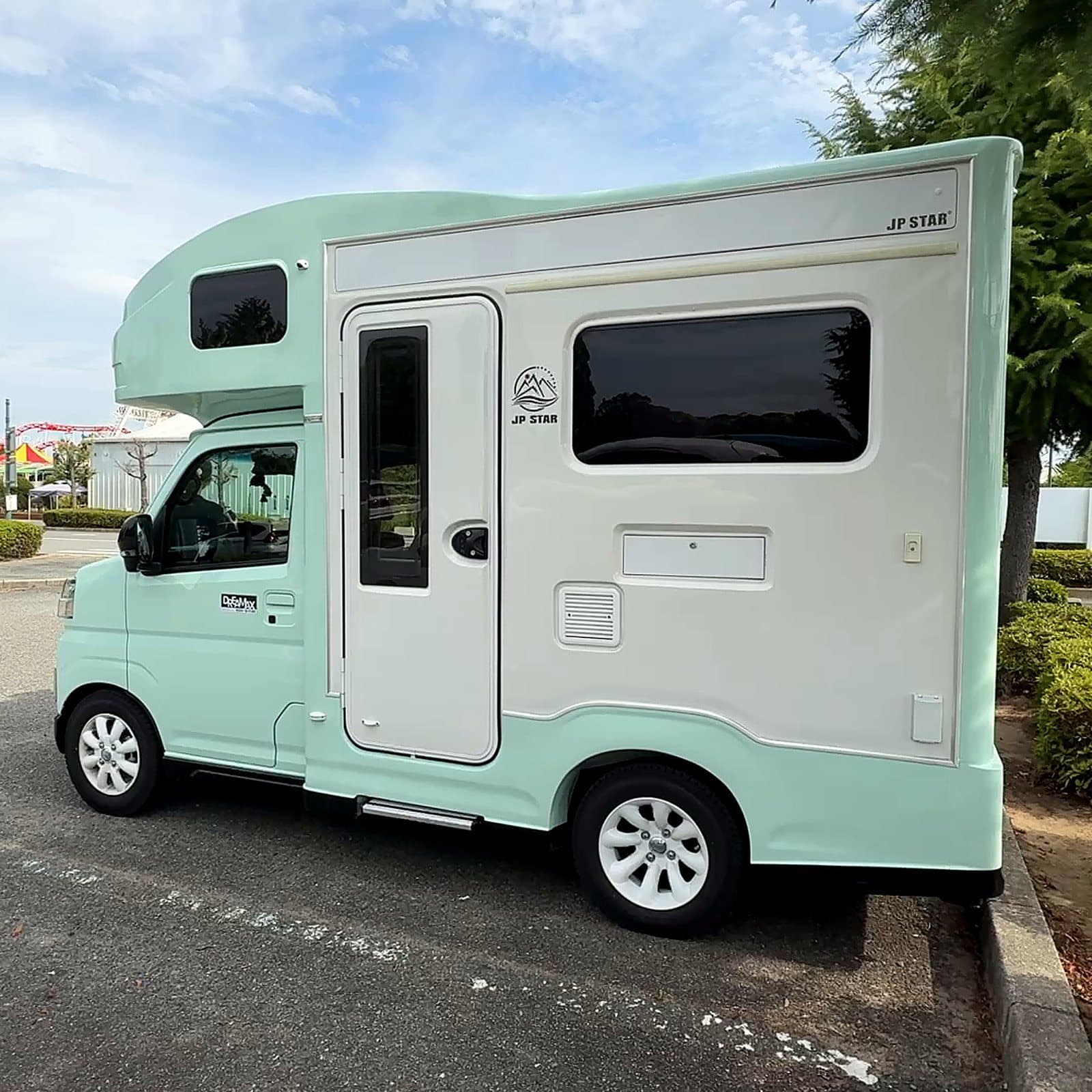
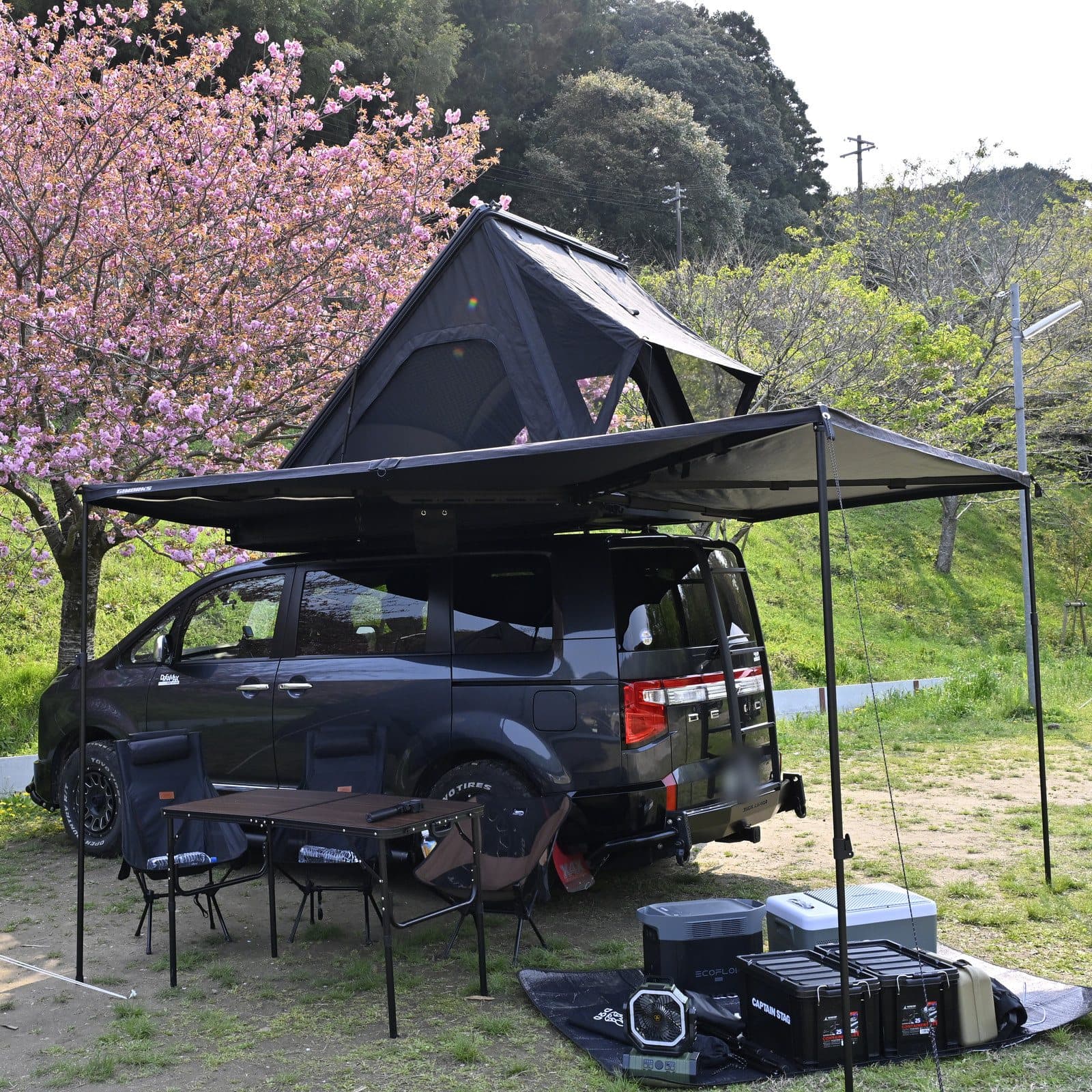
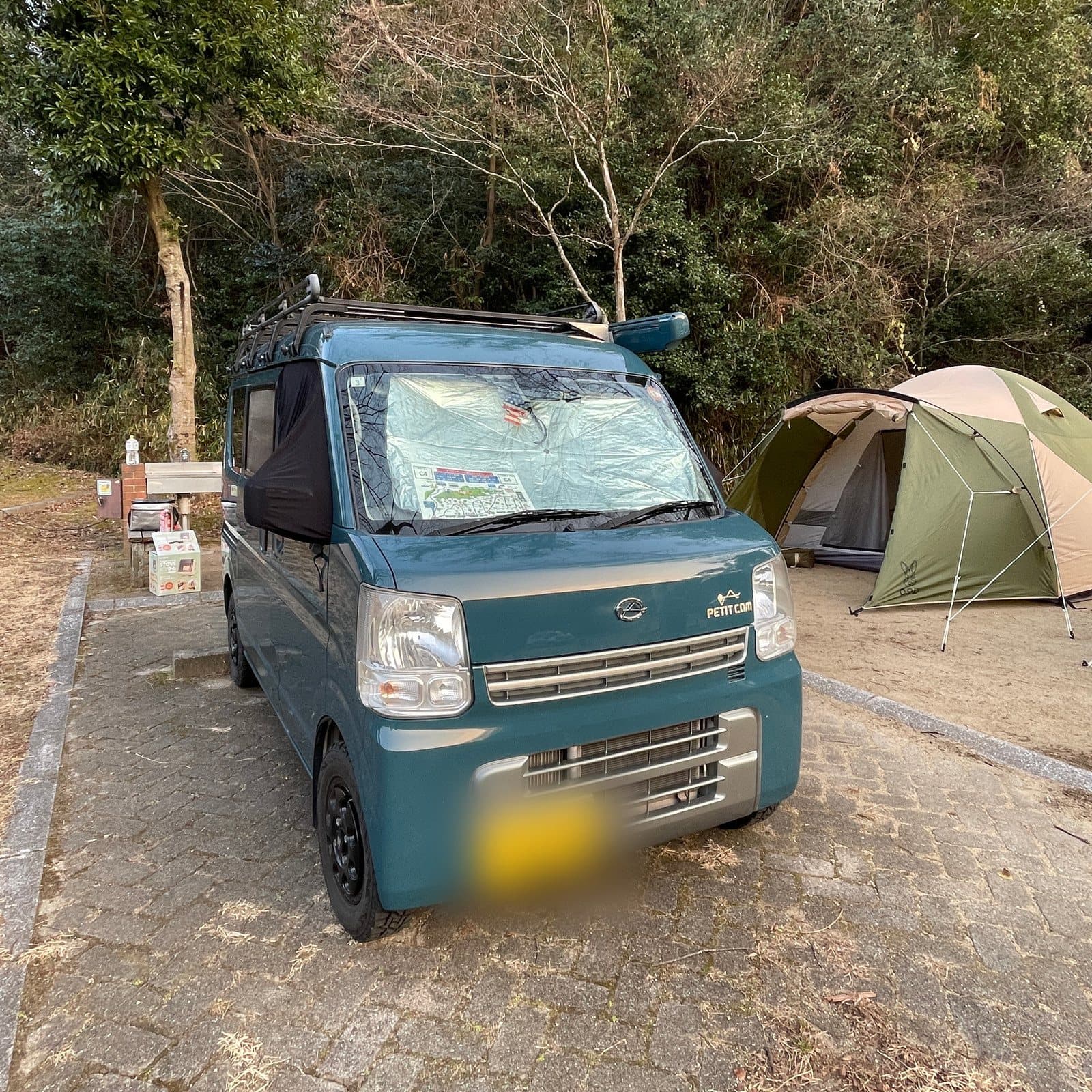
Treasure 1 (2.8 m tall) should be planned on the basis that it will not fit a multi-storey car park: choose open-air car parks or those with large-vehicle bays. With Happy 1 Turbo (2.6 m tall), avoid multi-storey car parks too. Of the other options, Delica D:5 (2.1 m tall) and Petit-Cam Villa (2.0 m tall) fit easily into ordinary open-air car parks, apart from multi-storey car parks with low height limits.
Some places, like Daigoji, have a large temple car park; others, like Kaizu-Osaki, have none of their own. Every day the rule is the same: arrive early, park, and move on before the crowds.
- Treasure 1: 4,900 mm long, 2,800 mm tall, sleeps 4 adults + 2 children
- Happy 1 Turbo: 3,880 mm long, 2,600 mm tall, sleeps 4
- Delica D:5: 4,950 mm long, 2,100 mm tall, sleeps 4
- Petit-Cam Villa: 3,395 mm long, 2,000 mm tall, sleeps 2
What it costs, and which van suits this trip
The cherry-blossom period, 25 March to 10 April 2027, is peak season, and every camper is charged its peak-season rate. That is ¥32,000 (¥35,200 incl. tax) a day for Treasure 1 and ¥28,000 (¥30,800 incl. tax) for Happy 1 Turbo, so five days in that period come to ¥160,000 (¥176,000 incl. tax) and ¥140,000 (¥154,000 incl. tax) respectively. The other options are ¥26,000 (¥28,600 incl. tax) a day for Delica D:5 and ¥16,000 (¥17,600 incl. tax) for Petit-Cam Villa.
From 11 April the weekday and weekend-and-holiday rates apply again, except in other peak periods such as Golden Week. Weekdays start from ¥20,000 (¥22,000 incl. tax) a day for Treasure 1, ¥16,000 (¥17,600 incl. tax) for Happy 1 Turbo, ¥14,000 (¥15,400 incl. tax) for Delica D:5 and ¥10,000 (¥11,000 incl. tax) for Petit-Cam Villa. The booking screen shows the rate for every day and the total before you pay.
The main campers for this trip are Treasure 1 and Happy 1 Turbo. Treasure 1 sleeps 4 adults + 2 children and is 4,900 mm long, for families and larger groups; Happy 1 Turbo sleeps 4 and is 3,880 mm long, a fit for four. Other options: for a roof-tent trip, Delica D:5 (sleeps 4 including its roof tent; open the tent at an RV park or campsite); for two, Petit-Cam Villa (658cc · AT · Turbo, sleeps 2, 3,395 mm long). Petit-Cam Villa's car page lists no on-board heater, so add sleeping bags for the mountain nights at Yoshino and Kawakami.
On a cherry-blossom trip, the day is made by reaching each spot first thing in the morning. In a campervan you can move to a roadside station nearby the evening before, and if the bloom runs off the forecast, you simply swap the order of the days.
Resting at a roadside station is free; RV parks and hot springs charge their own rates. Spring nights in the mountains can be cold, so add sleeping bags or other extras from the wide range on the booking screen.
Campers for this trip
FAQ
When are the cherry blossoms at their best in Kansai in 2027?
No bloom forecasts for 2027 have been published yet. In a typical year, Daigoji is best from late March to early April, Arashiyama in early April, Kaizu-Osaki around early April in recent years, and on Mount Yoshino, Shimo-senbon blooms in early to mid April and Oku-senbon in mid to late April. Once the forecasts are out, the bloom meter on this page is updated.
Can I drive a campervan to Arashiyama?
Yes, but the roads in the centre are narrow and most car parks are built for cars. The practical plan is to park in an open-air car park early in the morning and walk. Treasure 1 (2.8 m tall) will not fit a multi-storey car park.
Is there parking at Kaizu-Osaki?
There is no dedicated car park. The Biwako Takashima Tourism Association points visitors to the free car park at JR Makino Station, about an hour on foot or six minutes by community bus from the trees. In a typical year there are daytime traffic controls on the peak-bloom weekend.
Where do we sleep each night?
At the roadside stations Galleria Kameoka, Makino Oisaka-toge, Yoshinoji Oyodo i-Center and Sugi no Yu Kawakami. Resting in the van until morning is fine, but no camping behaviour. For a camping night, choose RV park Relacping Metasequoia or RV Park Lite Kamokimi no Yu.
Can a campervan get up Mount Yoshino?
According to the Yoshinoyama Tourism Association, the Yoshinoyama Kanko car park (about 400 cars) and the Nyoirinji car park (about 200 cars) are open all year, with extra car parks in the cherry season. There are traffic controls in the season, mainly at weekends, so check the association's page before you go and arrive early.
Can I pick up at Kansai Airport and drive this route?
Yes. Handover at Kansai Airport and in central Osaka is free. Allow a little more time from Kansai Airport to Daigoji than from central Osaka.
Related guides
Looking for more? All car-camping spots in Japan · Driving route library
See the 2027 cherry blossoms by campervan
See campers and prices