
Winter & Ski Guide
Winter Campervan Rental from Osaka: A Ski Trip Guide
Kansai's ski areas sit about one to three and a half hours from Osaka. Skip the hotel lottery, sleep at a roadside station or RV park near the lifts, and be first in the queue in the morning: that is the winter campervan trip. But winter punishes anyone who sets off without knowing which van carries which tyres, what to do with the water tank, and what actually runs the heating. This page covers all of it, exactly as DREAMAX vehicles are equipped.
By Gary, campervan & car-camping advisor at DREAMAX
Ski areas you can reach from Osaka, with rough drive times
Kansai is closer to snow than most visitors realise. Mt. Rokko, the hill behind Kobe, is about an hour from the city. Biwako Valley on the western shore of Lake Biwa is roughly one and a half to two hours. In northern Hyogo (the Tajima area), Hachi Kogen and Hachikita, plus Okukannabe, are about two and a half to three hours, with Kinosaki Onsen a short detour on the way home. Further out, Takasu Snow Park and Dynaland in Gujo, Gifu, are around three to three and a half hours: among the largest resorts in western Japan, with plenty of runs and reliable snow.
All of these times assume expressways and no snow disruption. In winter, Tajima and Gujo regularly see closures and speed restrictions, so add an hour of margin. Every vehicle has an ETC unit built in and the ETC card is lent free of charge; tolls are settled when you return.
- Rokko Snow Park (Kobe): about 1 hour. Mostly machine-made snow; families and beginners.
- Biwako Valley (Otsu, Shiga): about 1.5–2 hours. Views over Lake Biwa.
- Hachi Kogen / Hachikita (Yabu and Kami, Hyogo): about 2.5–3 hours. The Kansai classic.
- Okukannabe / Kannabe Kogen (Toyooka, Hyogo): about 3 hours. Kinosaki Onsen is about 40 minutes away.
- Takasu Snow Park / Dynaland (Gujo, Gifu): about 3–3.5 hours. Pick these for scale and snow quality.
Winter tyres by vehicle: studless versus all-terrain (3PMSF)
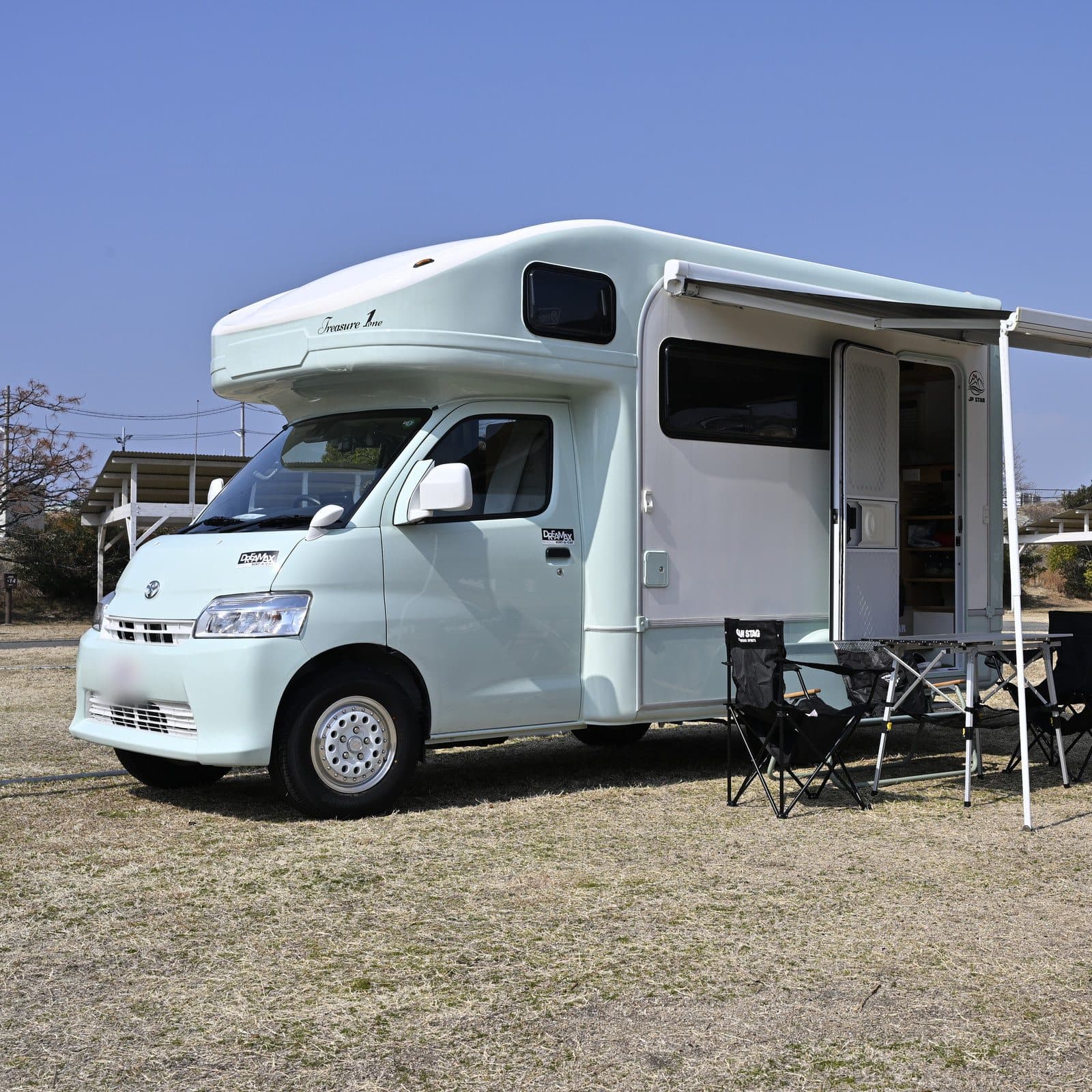
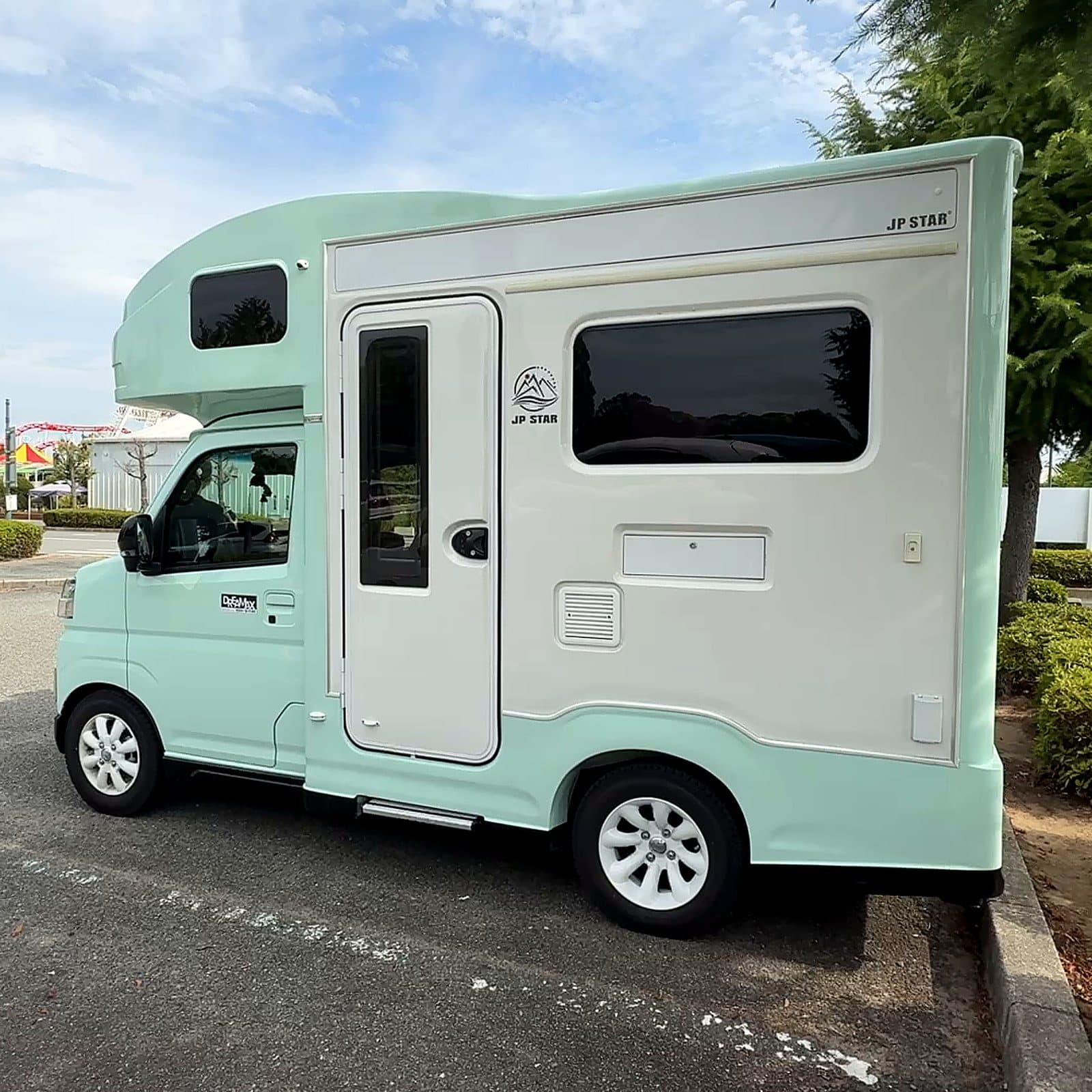
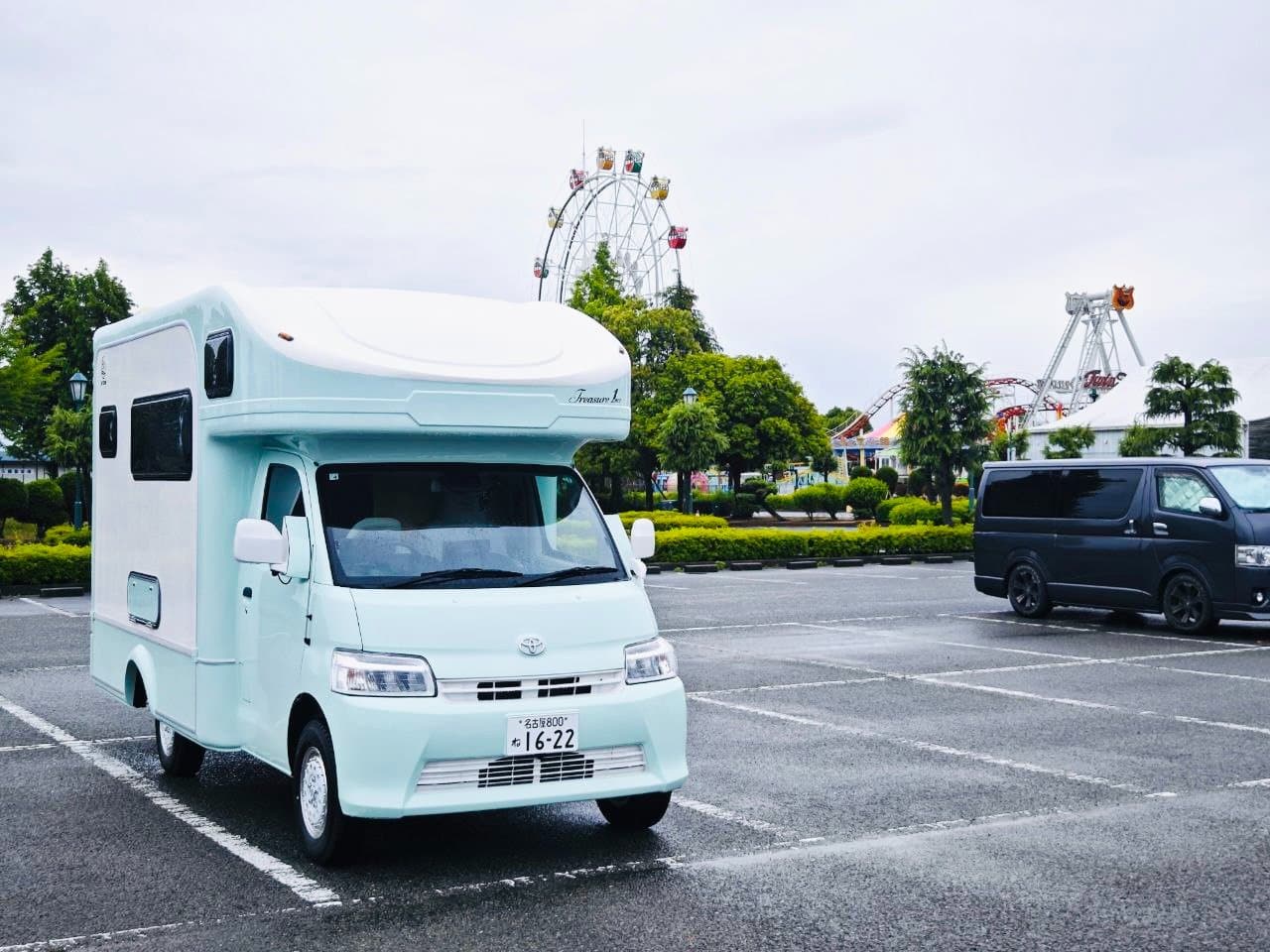
From November to April DREAMAX campers run one of two kinds of winter tyre, depending on the vehicle. Treasure 1 and Happy 1 Turbo carry studless winter tyres as standard. These are built first and foremost for grip on packed snow and ice, and they are the right tyre for the road up to a ski area.
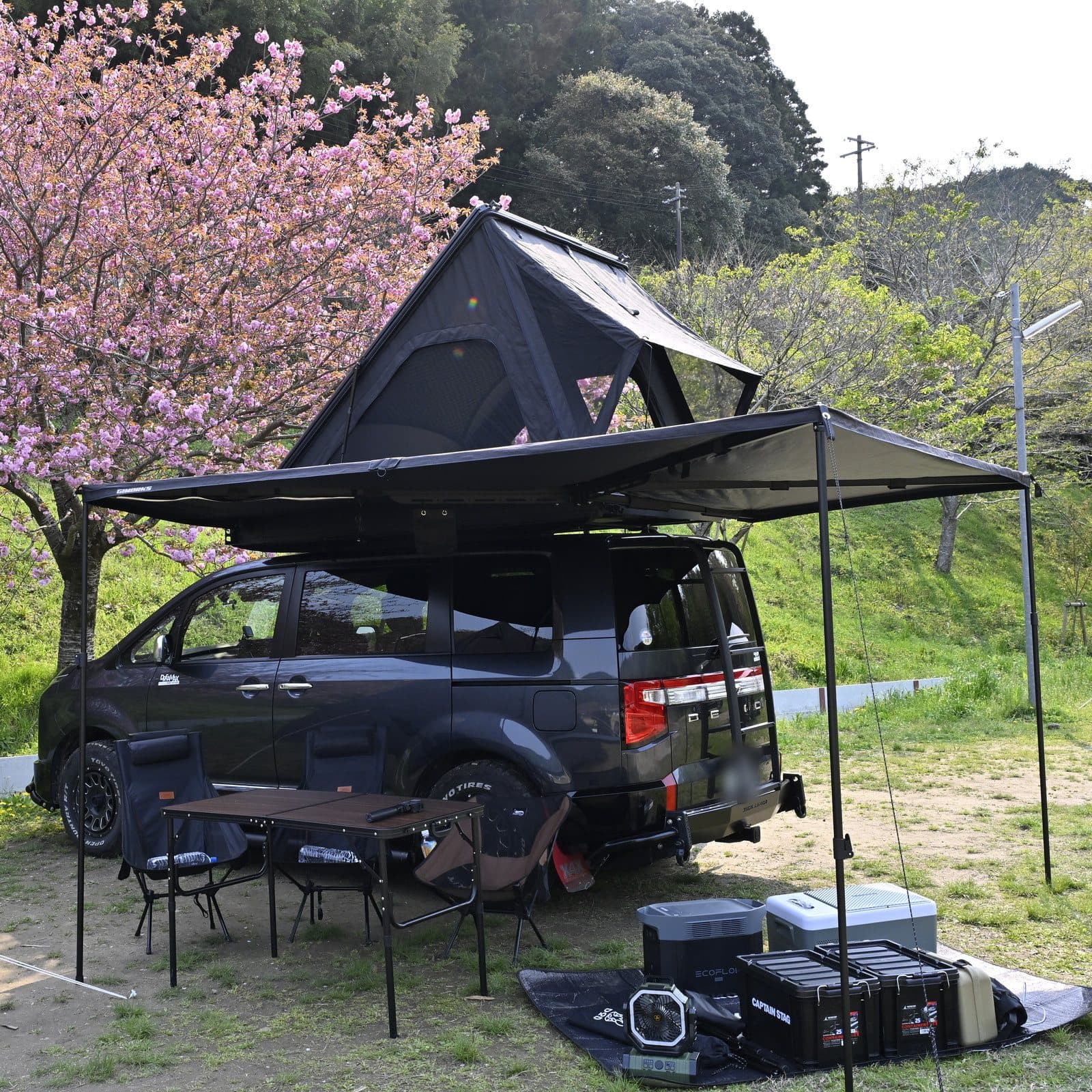
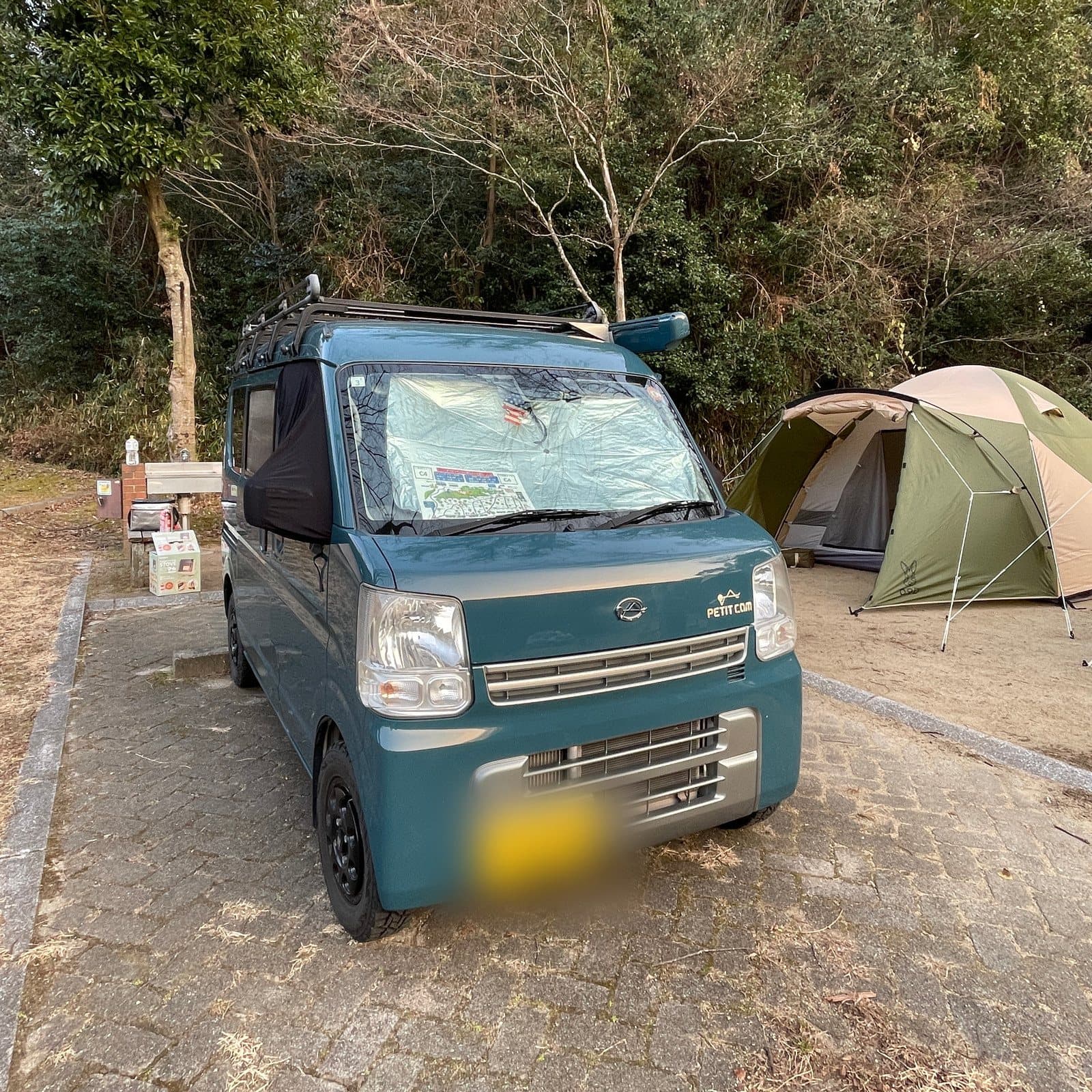
Delica D:5 and Petit-Cam Villa carry all-terrain tyres with the three-peak mountain snowflake mark (3PMSF). The 3PMSF symbol certifies severe-snow performance internationally and is legal on Japanese "winter tyre restriction" sections. But the design intent is different: all-terrain tyres are strong on mixed surfaces such as mud and gravel, and on glassy ice they do not hang on quite the way a studless tyre does. Treat resort car parks and shaded corners with extra care.
The GR Yaris and Can-Am Ryker are not available for snow areas in winter (November–April), so they are not candidates for a ski trip.
- Treasure 1 (1,496cc, 4WD): studless winter tyres standard, Nov–Apr
- Happy 1 Turbo (660cc, 4WD): studless winter tyres standard, Nov–Apr
- Delica D:5 (2,267cc diesel, 4WD): all-terrain 3PMSF, Nov–Apr
- Petit-Cam Villa (658cc turbo): all-terrain 3PMSF, Nov–Apr
Tyre chains: telling the two restrictions apart
Japan has two levels of winter road restriction. On a "winter tyre restriction" section, studless or 3PMSF tyres are enough. On a "chain restriction" section, chains must be fitted to the driven wheels even if all four tyres are winter tyres. The sign is blue with a tyre-and-chain pictogram, and it is applied on specific passes and expressway sections on days with heavy-snow warnings.
DREAMAX lends tyre chains to match your itinerary. Tell us where you are heading when you book. Fit them somewhere flat and safe, such as a car park, before you reach the restricted section; scrambling on the hard shoulder is the most dangerous option. We can go through the fitting procedure together at handover.
Drain the fresh-water tank before you go (the freeze rule)
This is Article 14 (4) of the DREAMAX rental terms. When a camper is taken into a snow area, or anywhere the minimum temperature falls below freezing, the fresh-water tank must be drained beforehand. If it is not, and the tank, pump or piping is damaged by freezing, the repair cost is borne by the renter.
The reason is simple: water expands as it freezes. Treasure 1's 60-litre tank feeds the kitchen and the shower, but the pipes running under the floor and inside the walls are narrow and can split in a single cold night. A split pipe is sometimes not discovered until spring, and the repair is expensive.
In practice, the easiest winter trip is one that never relies on the tank at all: bottled water to drink, the sinks at roadside stations or onsen for washing up, and onsen for bathing. Ski areas are surrounded by hot springs, so bathing is never a problem; the outdoor shower is for rinsing feet and sand in any case, not for bathing. The drain is under the vehicle and takes a few minutes.
Heating and power on board: the honest version
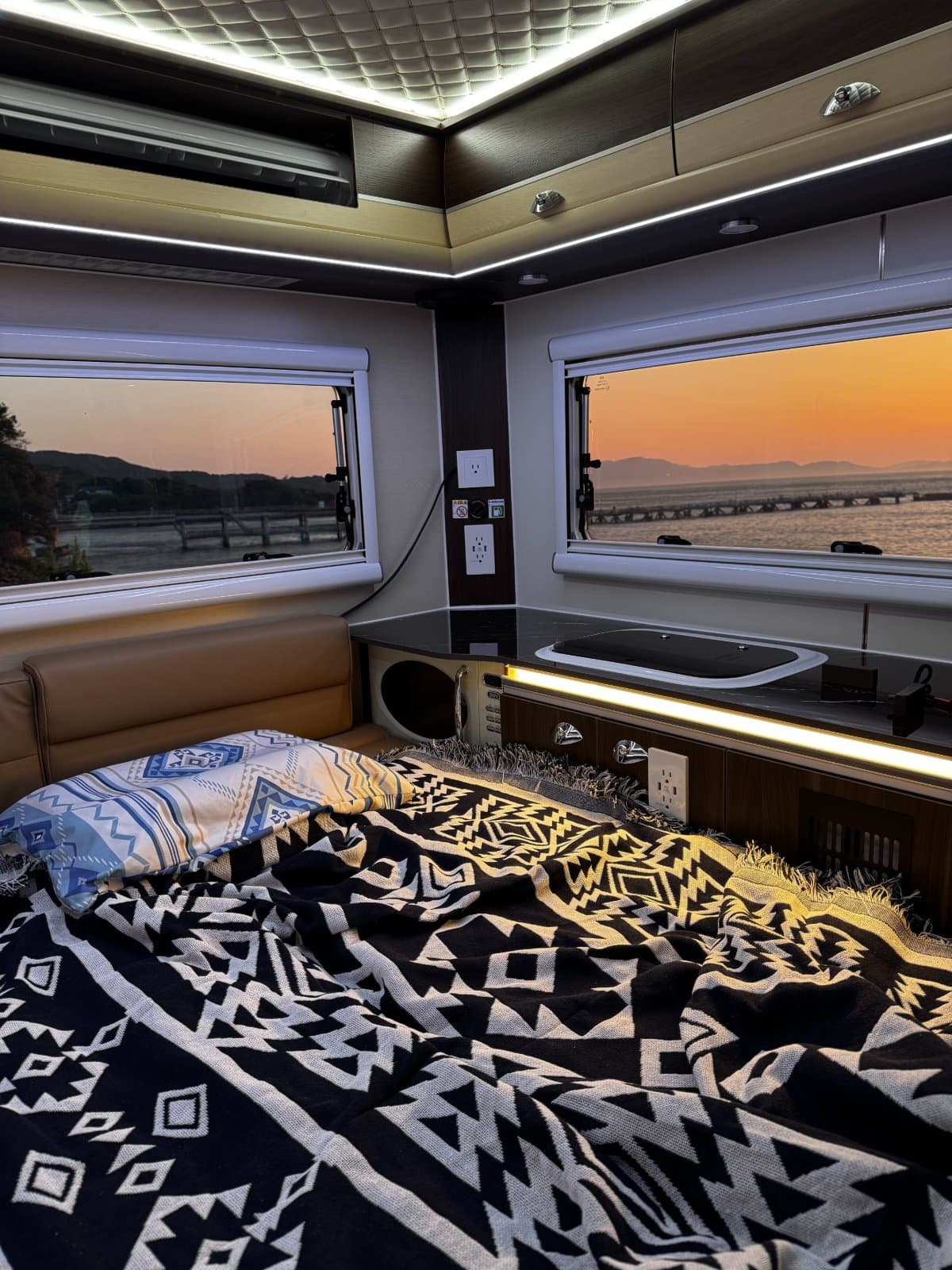
Treasure 1 has an FF heater (fuel-fired) plus electric household air-con heating: two heating systems. Happy 1 Turbo has air-conditioning, and an FF heater (fuel-fired) plus floor heating: two heating systems. The FF heater burns fuel, so it works without shore power; the air-con and the floor heating run from the same 400Ah (5,120Wh) lithium-ion battery and 3,000W inverter in both vans. These two are the vehicles where heating through the night with the engine off is realistic. Plug into shore power (100V AC) at an RV park and you can stop watching the gauge altogether.
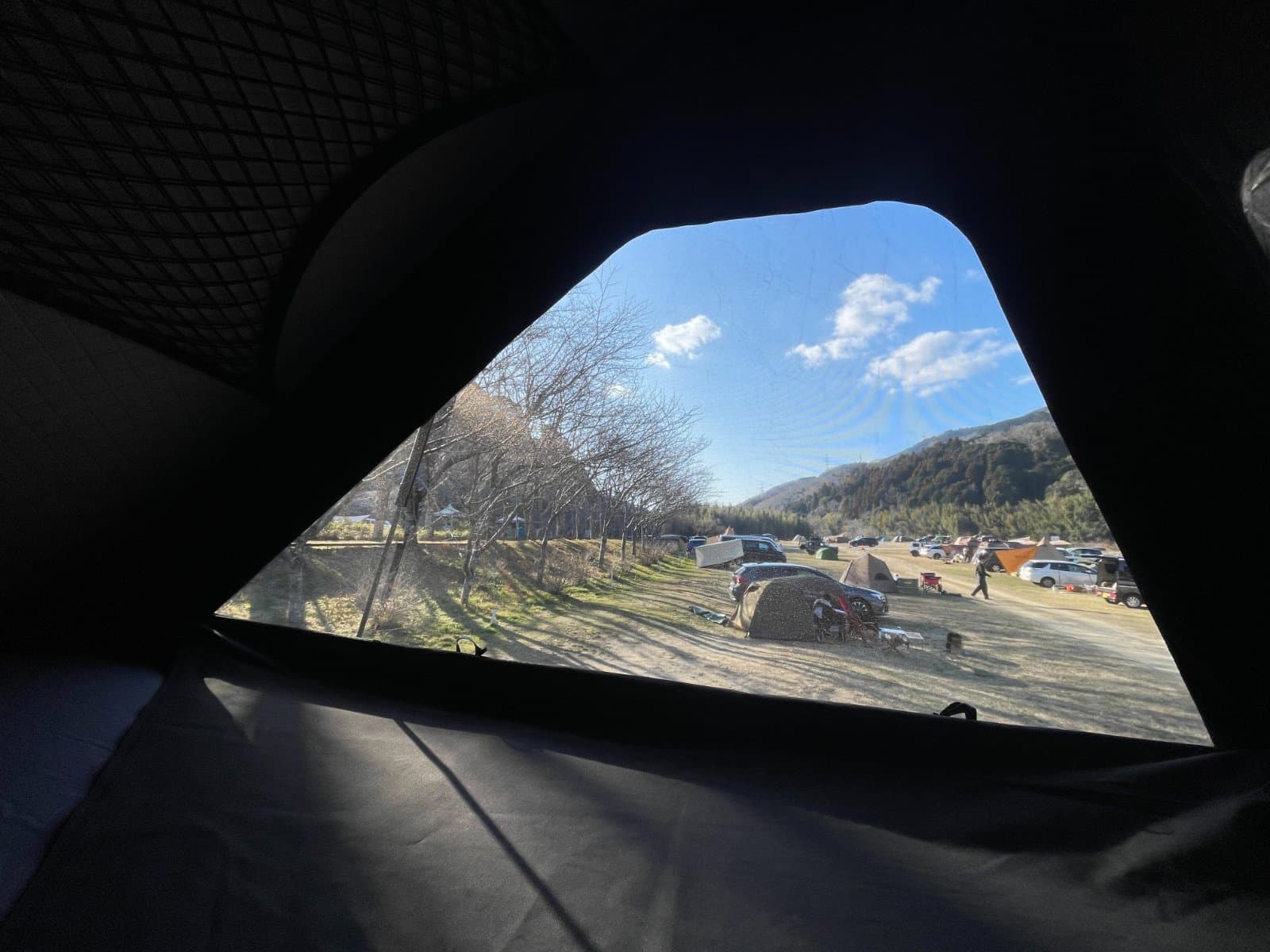
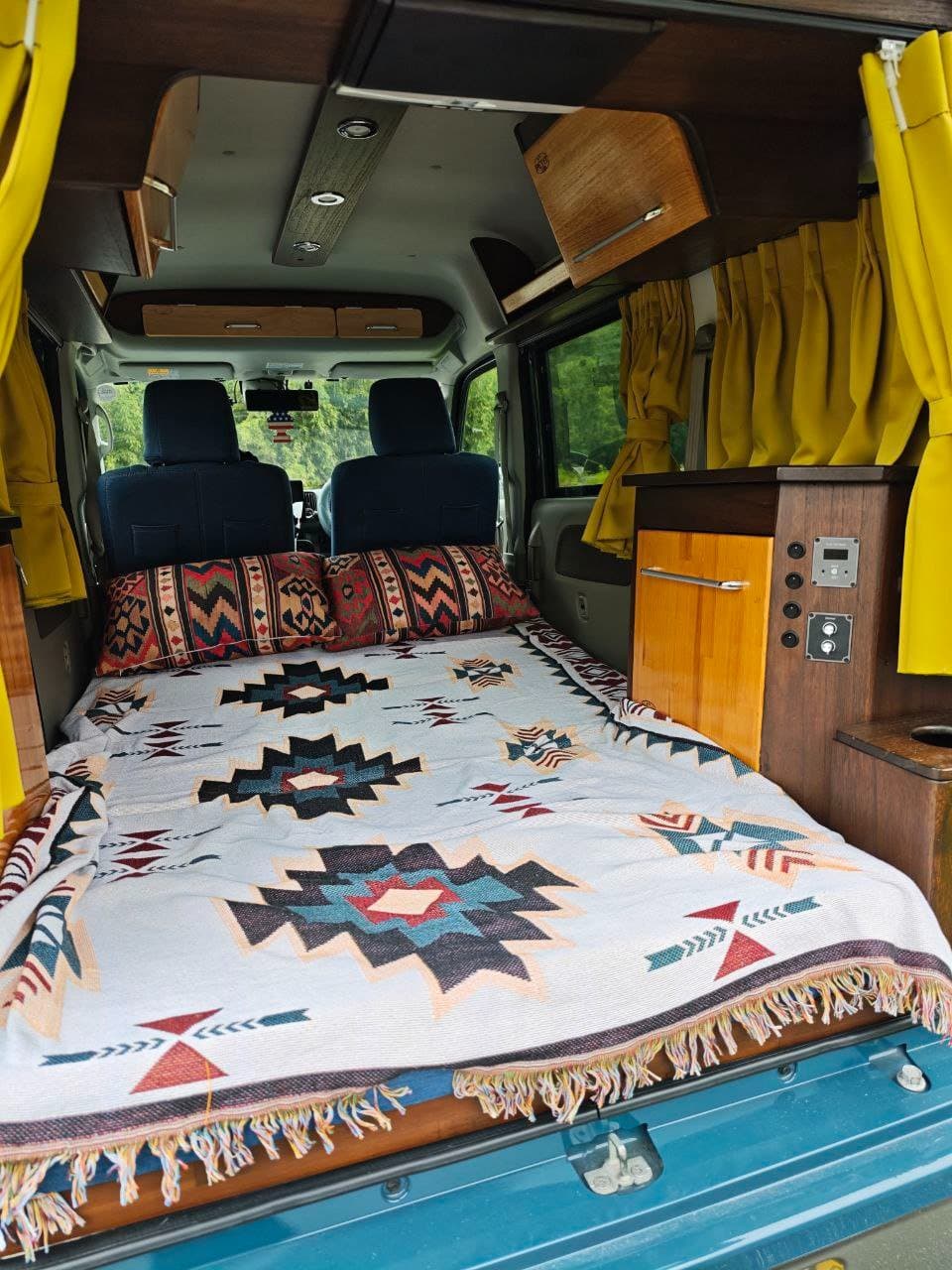
Delica D:5 and Petit-Cam Villa have no climate control that works while parked. The Delica's sleeping space is a roof-top tent, and the Villa is a kei camper with a flat bed. If you sleep in either of these in winter, heat comes from the rentable 1,200W ceramic fan heater (AC 100V) or from your bedding. The heater only runs all night where there is a mains socket, meaning a powered RV park pitch. Even with the rentable EcoFlow Delta 2 Max power station (2,048Wh), a 1,200W heater on high will not last two hours. Plan around bedding, not the heater.
DREAMAX does not recommend sleeping with the engine idling. Snow can bury the exhaust and push fumes into the cabin, and most roadside stations prohibit prolonged idling anyway.
- Treasure 1: FF heater plus household air-con heating (two heating systems), 400Ah / 3,000W, shore-power inlet
- Happy 1 Turbo: air-con, FF heater plus floor heating (two heating systems), 400Ah / 3,000W, shore-power inlet
- Delica D:5: no engine-off heating or cooling (roof-top tent)
- Petit-Cam Villa: no engine-off heating or cooling; ceramic heater (needs AC 100V) plus sleeping bag
- Rentable bedding: Coleman all-season sleeping bag, rated to -5°C with all three layers
Where to sleep in winter
You have three broad options. First, roadside stations (michi-no-eki): 24-hour toilets and resting or sleeping in the vehicle is allowed, with no set-up outside and no fires. In Tajima, Michi-no-eki Kannabe Kogen sits right in front of Okukannabe; Michi-no-eki Yoka Tajimagura is on the way to Hachi Kogen; and Michi-no-eki Tajima no Mahoroba is on the Kita-Kinki Toyooka expressway. For Biwako Valley, Michi-no-eki Imoko no Sato on the Kosei road; for Takasu, Michi-no-eki Dainichidake and Michi-no-eki Shirotori are the usual choices. Snow clearing can shrink the number of usable bays, so arrive before dark.
Second, RV parks. Powered pitches let Treasure 1 and Happy 1 Turbo run their heating without a second thought through the shore-power inlet, and you can take on water, drain and dispose of rubbish. Plan one every two or three nights. Some RV parks near ski areas close for the winter, so check opening status before you go.
Third, an onsen town. Kinosaki Onsen is about 40 minutes to an hour from Okukannabe and Hachikita, and a round of the public baths followed by a night at a nearby roadside station is a natural rhythm. Going back to the van already warm from the bath makes you far less dependent on the heater.
Driving on snow, for visiting drivers
Four-wheel drive helps you go; it does not help you stop. Treasure 1, Happy 1 Turbo and Delica D:5 are all 4WD, but braking distance on ice is decided by the tyres. Aim for half your dry-road speed and at least three times the following distance, and be gentle with both the brake and the steering.
Bridges, tunnel mouths and shaded bends can be iced even when the surface looks black (black ice). Early morning and dusk are the worst times. Treasure 1 stands 2.8 m tall and Happy 1 Turbo 2.6 m, so slow down early in strong crosswinds and on icy descents.
Obey chain-restriction and winter-closure signs without exception; the mountain road your sat-nav suggests may be closed for the season. Refuel early, and top up whenever the tank drops to half. Delica D:5 takes diesel; the other three take regular petrol.
What to pack for winter
Ski gear can be hired at the resort, but the kit for living in the van is worth sorting out yourself. Here is what DREAMAX rents, and what is worth bringing yourself.
- Sleeping bag: Coleman all-season (rentable), rated to -5°C with all three layers.
- Ceramic fan heater, 1,200W (rentable, AC 100V), for powered RV-park pitches.
- EcoFlow Delta 2 Max power station, 2,048Wh (rentable), for phones and small devices.
- Iwatani cassette stove with three gas canisters (rentable). Ventilate while cooking.
- Bottled drinking water, because the tank travels empty.
- Snow brush, ice scraper, work gloves and a small shovel for the morning dig-out.
- Hangers and a line for wet ski clothes, and ventilation against condensation.
- A down jacket and thick socks; you will use them inside the van too.
Budget example: a 4-day, 3-night ski trip
Using the weekday rates (excluding tax) from the vehicle pages: Happy 1 Turbo from ¥16,000 per day, Treasure 1 from ¥20,000, Petit-Cam Villa from ¥9,000. Weekends and peak season are priced separately, and Lunar New Year 2027 (13–21 February) counts as peak. Seven days or more earns an automatic 10% discount. There is no minimum rental length.
Happy 1 Turbo, four weekdays, Hachi Kogen and Kinosaki Onsen: vehicle ¥16,000 × 4 days = ¥64,000 (excl. tax); tolls about ¥6,000–8,000 return; fuel about ¥6,000; one RV-park night about ¥3,000–5,000; two roadside-station nights free; onsen about ¥700–1,000 per person per visit. Split four ways, with accommodation included, the per-person cost is modest. Vehicle insurance, the cleaning fee and the deposit are separate and shown on the vehicle page and in the breakdown before you pay.
Handover is free at Kansai International Airport (KIX) and in Osaka city. You can head for Tajima on the day you land, but DREAMAX suggests a first night around Osaka or Kobe to get used to the van before you meet snow.
Campers for this trip
FAQ
Do winter tyres cost extra on a winter campervan rental?
No. From November to April, Treasure 1 and Happy 1 Turbo carry studless winter tyres as standard, and Delica D:5 and Petit-Cam Villa carry 3PMSF all-terrain tyres. There is no surcharge on any of them.
Can I borrow tyre chains?
Yes. DREAMAX lends chains to match your itinerary; tell us your destinations when you book. On a "chain restriction" section, chains are required even on winter tyres.
What happens if I drive to the snow with water in the tank?
The pipes or pump can freeze and split, and under Article 14 (4) of the rental terms the repair cost is borne by the renter. Drain the tank before entering any snow area or anywhere below freezing.
Can the on-board heating get me through a winter night?
Treasure 1 (FF heater plus household air-con heating) and Happy 1 Turbo (FF heater plus floor heating) both have two heating systems; the FF heater works without shore power, and with the 400Ah battery as well a full night of heating is realistic. Delica D:5 and Petit-Cam Villa have no heating that works while parked, so use the ceramic heater on a powered RV-park pitch or rely on the -5°C sleeping bag.
Which ski area is closest to Osaka?
Rokko Snow Park is about an hour away and Biwako Valley about 1.5–2 hours. For proper skiing, Hachi Kogen / Hachikita (about 2.5–3 hours) or Takasu Snow Park / Dynaland (about 3–3.5 hours) are the better choices.
Can I collect the van at Kansai Airport and drive straight to the slopes?
Yes. Handover at KIX and in Osaka city is free. DREAMAX does suggest avoiding snow driving straight after a long flight, though: spend the first night nearby and head for the mountains the next day.
Can I take the GR Yaris to the snow?
No. The GR Yaris and Can-Am Ryker are not available for snow areas in winter (November–April).
Can I sleep at a roadside station in winter?
Yes. Resting and sleeping in the vehicle is allowed at roadside stations with 24-hour toilets (no outdoor set-up, no fires). In winter, snow clearing can reduce the number of bays, and DREAMAX does not recommend sleeping with the engine running.
Related guides
Looking for more? All car-camping spots in Japan · Driving route library
Choose your winter camper
See vehicles and rates